The Great Dissonance: We don’t like small parties, so why do we keep voting for them?
A subscriber recently reached out with a classic political conundrum:
“The attached Stuff poll (highly unscientific vibe wise but likely accurate enough) says most people don't want the smaller parties calling the shots. But more and more people are choosing them exactly so that they can. National and Labour are losing voters to the minor parties at the same time as being criticised for giving them too much power. Reconcile?”
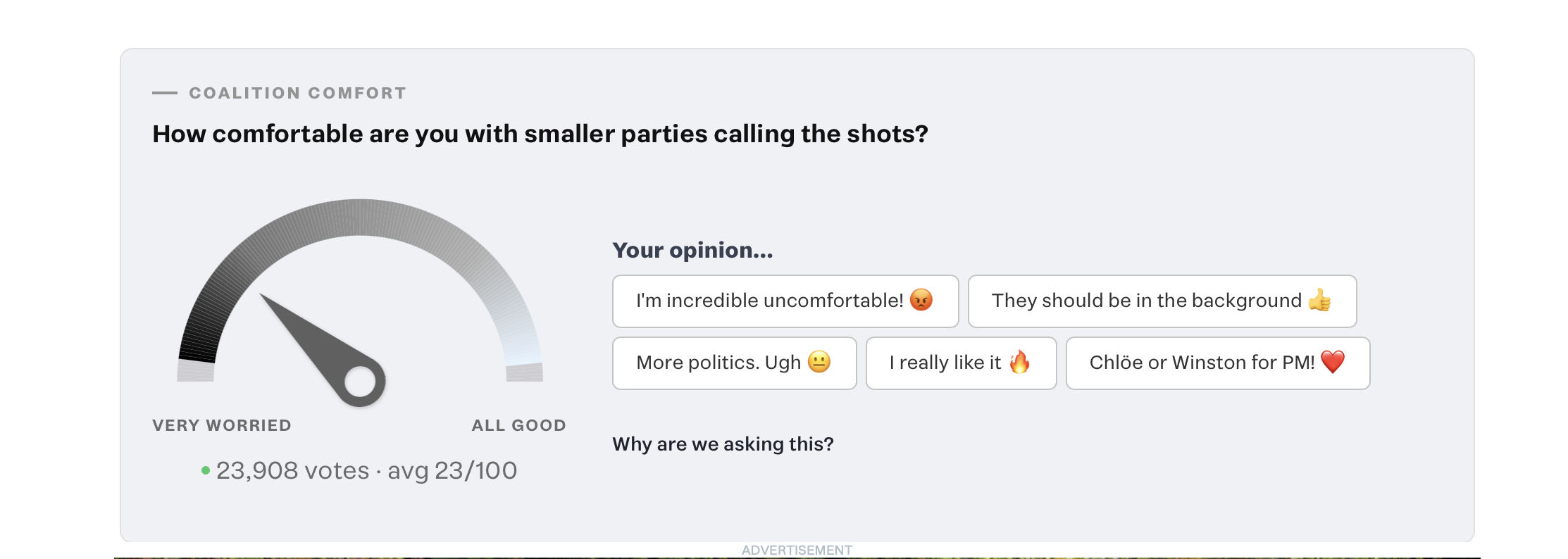
The textbook answer is cognitive dissonance – the discomfort we feel when our beliefs clash with each other or with our behaviour, and the lengths we go to ease it.
Politics runs on it. Voters want both lower taxes and shorter emergency department wait times. They want the state to fund superannuation for a rapidly growing proportion of New Zealanders and they want the age of super to remain at 65. They want a leaner public service and expect immediate government intervention the moment something goes wrong. Normally, voters never have to reconcile these contradictions; they just hand them over to a newly elected government and blame it when it can't resolve them.
The same thing is happening with minor parties. Voters say they resent small parties wielding disproportionate power. Yet they keep moving their votes to them, often in protest at major parties that no longer seem to listen.
Some of what’s happening here can be explained by what I wrote in my last column. When polls are volatile, voters can waste a lot of effort planning their voting choice on what they think other voters are doing. When prompted by the Stuff quiz to consider minor parties "calling the shots," voters will be criticising other voters’ minor parties. The ACT voter would have remembered NZ First dragging its anchor on more radical economic reforms. The Green voter would have recalled ACT pushing an anti-Tiriti platform.
But when that same voter steps into the polling booth, they think only of their own chosen party as the cure, not the disease. An ACT voter sticks with ACT to prevent National from veering into the centre. A Green voter sees their party vote as the only way to keep Labour on the left.
The Stuff quiz suggests voters don’t like the collective minor party outcome their combined choices produce, yet no individual voter feels responsible for the specific vote they cast.
Usually this contradiction stays hidden. But this election, private citizens are asking National voters to take the contradiction into the polling booth and act on it.
Cue Harry Mowbray’s recent website https://splityourvote.co.nz telling National supporters they MUST (his capital letters, not mine) tactically sacrifice National's party vote share in favour of minor parties ACT and NZ First in order to game the overhang provisions allowed for under the MMP electoral system and return a centre-right coalition.
Mowbray's plan asks National voters most irritated by the influence of ACT and NZ First to manufacture the very outcome the Stuff poll says they fear and give those same parties a bigger share of centre-right coalition government power. Mowbray frames this as "swallowing a rat" – accepting a deeply uncomfortable act now to prevent a Labour-led government.
If doing it for this election is hard to swallow, the promise that it should continue indefinitely is a harder sell still. "If we can learn to strategically split our votes like this in future elections," Mowbray writes, "a centre-right coalition will retain the Treasury Benches for the foreseeable future." That asks National voters to vote against their own preference, and live with the discomfort, for more than one election.
This presents a longer-term problem for National, as dissonance can't be sustained forever. Most voters eventually resolve it, and the usual way is to change what they believe to match what they keep doing. While a National voter who party-votes ACT once is swallowing a rat, one who does it every election stops being a National voter. In the longer term, Mowbray's plan converts National's voters into another party’s.
It is not obviously beneficial for ACT either. If National voters followed the instructions to the letter, ACT would sacrifice Epsom and Tāmaki. As long as ACT clears five per cent in the party vote, ACT won’t lose Seymour. But it would lose its insurance policy. Epsom has been ACT's lifeline whenever its party vote has collapsed.
The dissonance doesn’t stop there. Should there be a substantial National electorate overhang as envisaged under the Mowbray plan, the size of parliament could expand considerably. Many centre-right voters are fiscal conservatives who instinctively dislike a bloated Parliament. A leaner, cheaper state is one of their most consistent demands, and the number of politicians is a favourite symbol of waste. To keep Labour out, voters who want fewer politicians are being asked to create more of them and at the taxpayer's expense.
Although Mowbray is supported by a roll call of right-leaning strategists, family, and libertarian advocates, resolving cognitive dissonance isn't a mass event. It occurs one voter at a time, inside the normally private gap between personal values and voting behaviour.
On 7 November we will find out whether this recipe has survived the privacy of the polling booth. The choices will likely come down to which discomfort a National voter wants to avoid more. Those who think minor parties already wield too much power, want a smaller parliament and don’t like being instructed how to vote by an outside influencer will probably tick National twice and sleep well. Those already drifting toward ACT or NZ First will find the rat goes down easily, because they had half-swallowed it already.
The great dissonance of MMP isn't really about minor parties. It's about the major ones. Voters want stable government but don't trust National or Labour enough to give them a greater share of the party vote. Until the major parties fix that problem, the dissonance highlighted by the Stuff snap poll will keep growing.