The back-to-the-future election
This is quite the back-to-the-future election. New Zealand First is re-treading former MPs and familiar faces, and ACT has unveiled veteran broadcaster Paul Henry as a list candidate. Winston Peters is quick to point out that his party list is full of new names too. Fair enough. And it isn't quite fair to file Henry alongside Laws, Ngaro, Nash, and Hipango-Brownlie, either. Henry is more entertainment than used furniture.
What is it about this point in our political history when the comfort of political and media survivors has become such a selling point?
First there is the redemption and conversion narrative; candidates ejected from their original political party have seen the light – turned from the old faith, renounced their former sins, and been resurrected under a new leader. It’s a time-old story that the news media lap up. For Michael Laws, who started as a National MP in 1990, converted to NZFirst in 1996, and resigned from Parliament the same year following a scandal, this is redemption. Paul Henry abandoning support for National to follow his new BFF Dave Seymour is conversion in a different church.
They are also a visual manifestation of the sentiment underlying much of NZFirst and ACT’s votes – the sensation of being spoken for by someone who visibly annoys the people they believe ignore them. Returning to the public eye after being let down by their former parties, these candidates are a physical two-fingered salute to the parties that wrote them off. The New Zealand Herald said as much in a published piece over the weekend titled ‘New NZFirst candidates savage National, Labour as they complete conversion.’
Then there is nostalgia itself. Bringing back experienced faces supports NZFirst’s agenda to ‘make New Zealand great again like it was when we were the number one democracy in the world.’ This is a nod to the 1950s and ‘60s when we were amongst the countries at the top of world for our high standard of living and GDP per capita. Before the economic shocks of the 1970s and the structural upheavals of the 1980s.
Similarly, over the weekend new ACT candidate Paul Henry, wearing distinctly rose-tinted glasses, spoke fondly of the period of his youth (the 1960s) to champion a return to a culture of individual success, ambition, and minimal state intervention. In a Q+A interview with Jack Tame he described the post-war era as a country built by ‘pioneers’ where people took individual responsibility. Back then, ‘no one was handing me an excuse for not performing in my life. No one was offering me reasons for my own failure before I had even tried.’
Tame reminded Henry that the top marginal tax rate of that time was over 60 per cent in order to fund many New Zealanders into housing. Surely he was not advocating a return to that? No, it was about the aspirational ‘vibe’ said Henry, the cultural mindset of the time.
There is a distinct cray cray in Peters’ and Henry’s desire to return to the vibe of a period when we could only be wealthy as a nation because Britain was taking most of our agricultural exports and the war in Korea of the early ‘50s drove an enormous wool boom. Unless Peters’ magical powers extend to restoring Britain as our exclusive export market, that time isn’t ever coming back.
Nor does the myth of egalitarianism and social stability implied by Peters and Henry hold up under scrutiny. Those pioneers that Henry remembers so fondly had built their nativity and prosperity off land confiscated, stolen, or bought from Māori at dirt cheap prices thanks to legislation that was never consented to by Māori. By the 1960s, New Zealanders of European descent made up over 93% of the total population, Māori were relegated to low-wage manual work and denied access to the housing subsidies of the white urban families. Women were not encouraged to work; their primary role was to stay home and raise children. They could not have separate ambition. They couldn't even take out bank loans without a husband's signature. Shops were shut at the weekend. You had to go on a waiting list of months to a year to own a car. When television arrived in 1963 there was one channel.
The self-reliance both men remember so fondly was underwritten by a very large number of people who were not permitted to be self-reliant. It was the dire - not ambitious - vibe of the 1960s that saw the rise of the women’s, Treaty and other rights movements of the 1970s that Peters and Henry’s children and grandchildren benefit from today.
No, Peters and Henry’s calls to return the country to greatness aren’t really a serious wish to return to these decades so much as a desire to protect the aspirations of the past from being eroded any further.
For most of the postwar era the future was a promise: progress, modernity, rising incomes, children better off than their parents. Forward meant better and more. Now forward means less and worse – wild weather, debt, an unsteady job market, over-full hospitals, and the ladder hauled up behind the boomers whose wealth depends on nothing changing. The nostalgic past lets NZFirst convert loss of the old promises of the future into betrayal – by immigrants, globalists, the elitist status quo, cloistered university academics, communist anti-democratic losers and snivelling wokesters. It’s a message targeted to appeal to anyone who feels let down by ‘the system’ and wants someone else to name and blame.
Blame deflection
The blame game is also a tool to avoid having to accept responsibility for the present. With earnestness this week, Peters told William Terite on Pacific Mornings that NZFirst will sort out the current economic mess if elected in 2026. This is the same Peters who enabled and then sat in the 2017-2020 Labour government as Deputy Prime Minister when it ran up the massive Covid debts that the current Government, of which he has also been Deputy Prime Minister, keeps complaining about. The same Peters who enabled this 2023 Government that has failed to deliver on its promises to restore the cost of living.
He has proved, time and again, incapable of delivering the return to greatness his male brethren crave, even from inside the tent. So why would anyone believe he will suddenly start delivering after November? Give us the tools and we'll finish the job, he says. If being Deputy Prime Minister is not a tool, what is?
But the question assumes New Zealand First voters are buying policy outcomes. Mostly they aren't. Few observers, including its own voters, expect the party to administer well. It is judged on direction, effort and defiance. Is Peters still fighting? Are Luxon and Willis squirming?
Even the $1billion oil search Peters announced over the weekend is a game of both nostalgia and blame deflection. The one time he turns his face to the future it is to a nostalgic, nationalist energy source and a gamble akin to Muldoon’s Think Big. The ever-mercurial Peters was Deputy Prime Minister when the oil and gas ban went on in 2018, and Deputy Prime Minister when his own minister took it off in August 2025. Now he wants a billion dollars for a search, the success or failure of which lands many elections away.
It suits the party to keep the business unfinished, the promises out of reach. Peters is not offering a solution but a direction where there is more satisfaction in the grumbling than in making real change.
Squirmy, wormy
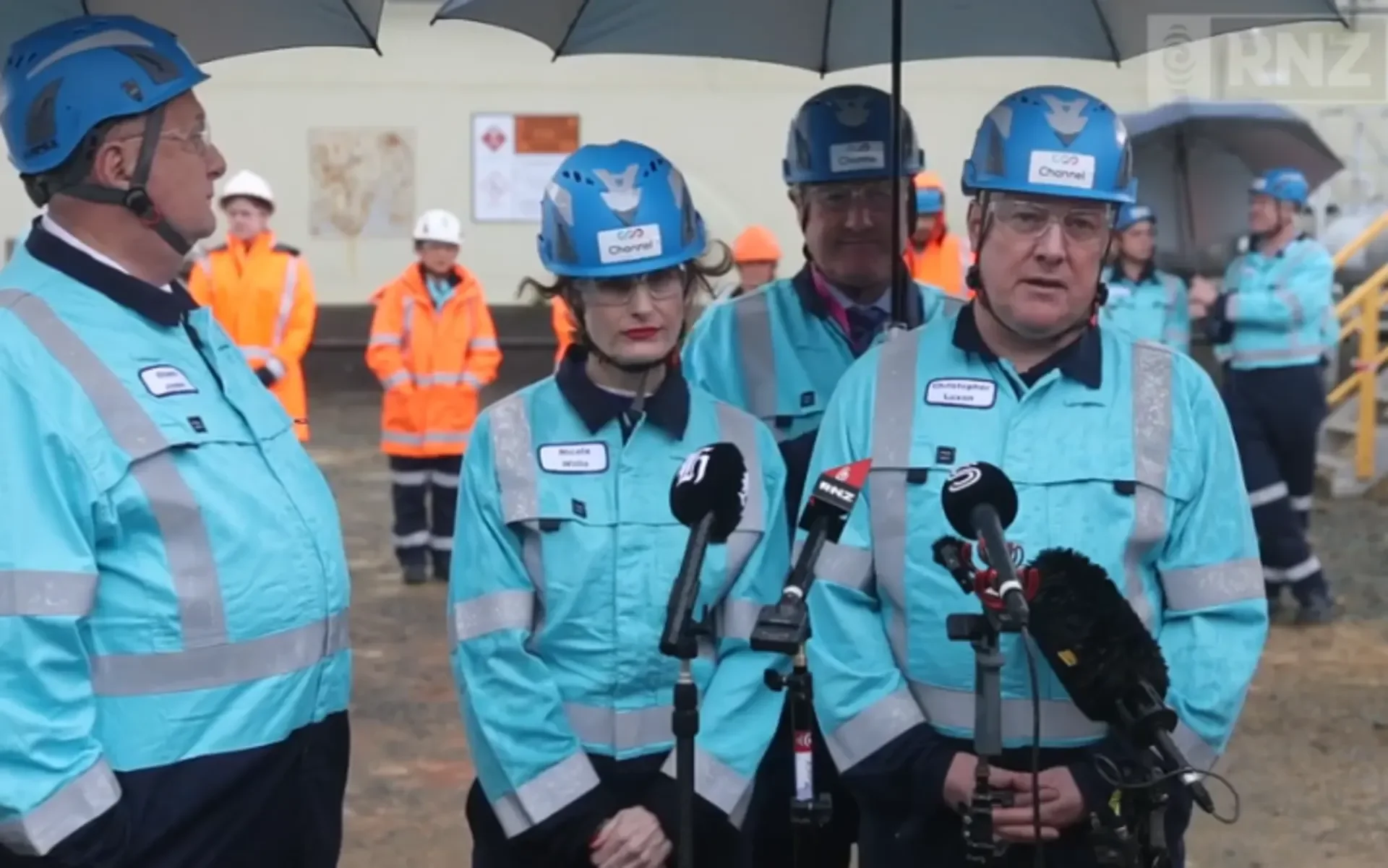
Speaking of squirming, the photos below of an uncomfortable Luxon and Willis at Marsden Point, announcing the refill of the fuel tanks on 7 July, speak volumes. The first is by Getty, which has a habit of catching the real moment that the staged shot can't. The second by RNZ.
The government tipped $21.6 million from the Regional Infrastructure Fund (RIF) into refurbishing tanks left idle since 2022, then filled them with about nine days of the country's diesel – while paying Channel Infrastructure roughly $1.2 million a month in storage fees to the end of 2027. So the taxpayer now rents back capacity we used to own, to hold a buffer of a week and a half, bought in a hurry as Hormuz wobbled at the beginning of the US-Israel war on Iran. It is hugely expensive cover.
Everyone looks embarrassed except Winston, who is nowhere near it, despite this being a decision heavily driven by his party and funded through the RIF, which was established as a core condition of New Zealand First's 2023 coalition agreement with the National Party. Not only will Peters never be seen pulling on a hard hat, but he stays well clear of physically associating himself with initiatives that might backfire. It helps that his Foreign Affairs portfolio keeps him offshore for much of the time.
Those who had to front up are the PM, Nicola Willis, and Shane Jones – who seems always happy to perform a support role, especially if there’s dress up involved. (I did enjoy that they had their own name tags embroidered.)
For National, the hard hat photos are a ‘surrender of frame.’ Standing at Marsden Point, Luxon and Willis are extras in Winston Peters’ film. The set is pure nostalgia – the country stopped making things and left itself exposed. The props are his: the tanks, the diesel, the location.
This is one of the reasons why National's attacks on Peters keep missing. They are not fighting him. They are endorsing his preservationist narrative, even when it makes no financial or rational sense. Because whatever the jabs about Peters drifting to Labour, National will do anything to keep NZ First propping up the next coalition – even if, for Willis, it costs her a list place as National bleeds votes to NZFirst.
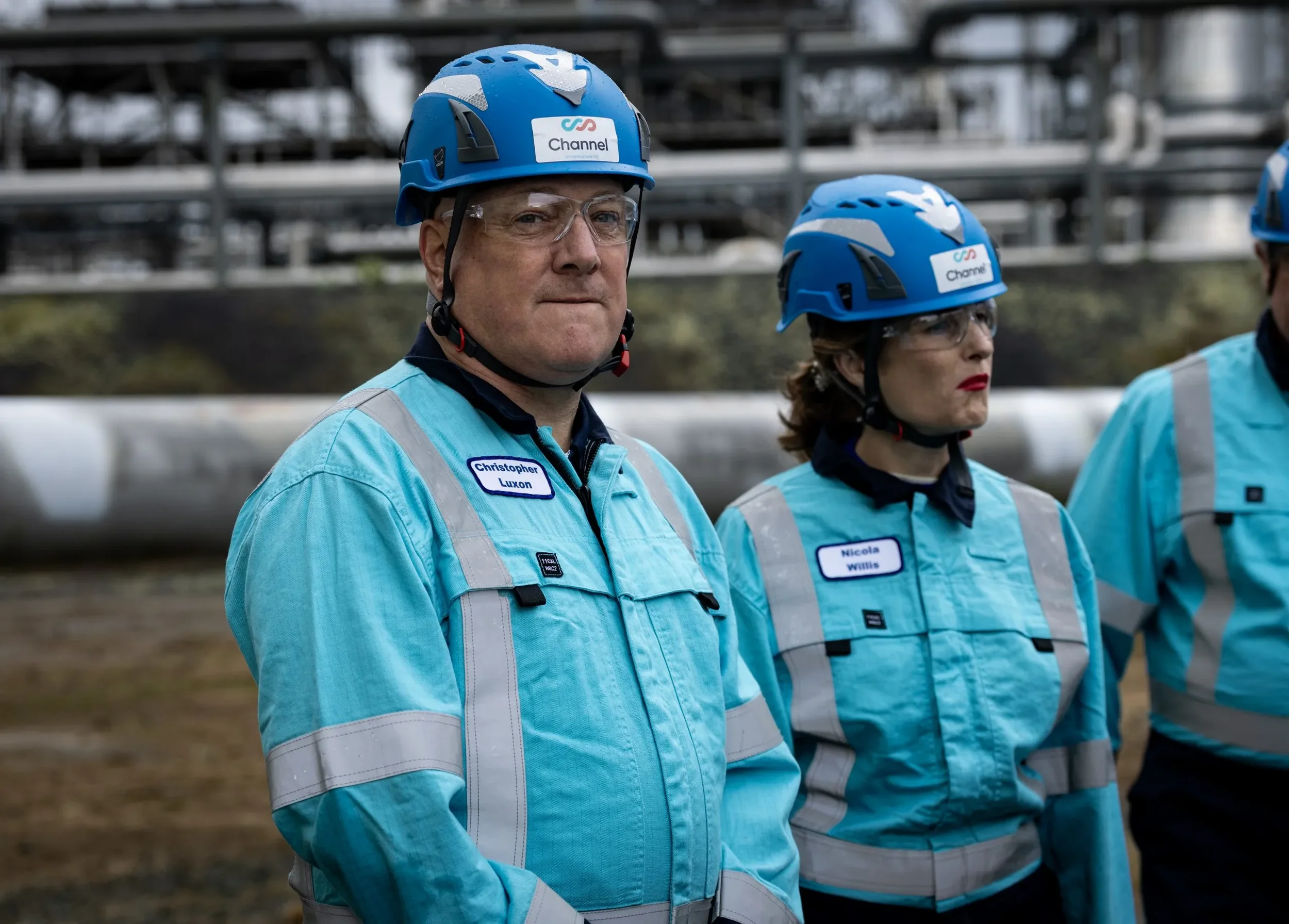
Photo: Getty Images
Riding the nostalgia wave
The centre parties are also riding their own nostalgia wave. Labour and National are realistic enough to know the past can't be delivered – it's gone, it's unaffordable, it was never fair. But they are also stuck repairing the wreckage their earlier incarnations left them, tied to a constituency that still expects house prices to rise, taxes to stay low, and a pension for life starting at 65. They can't move toward higher taxes, a higher retirement age or toward sustainable or lower growth, without frightening their property-owning, ageing base. So they end up incrementally managing a status quo that a growing share of locked out voters – the 38 per cent I wrote about last week – can’t see themselves in.
Soft nostalgia is visible in their slogans. Labour: ‘New Zealand should be a place where good jobs pay well and young people choose to stay, build their futures, and raise their families.’ National: ‘to build a prosperous, resilient and secure New Zealand.’ Neither is a compelling, exciting vision for the future.
Which is what makes the Opportunity Party interesting. It is selling a future without being hostage to the past. ‘Expect better.’ A sustainable, high-wage economy. Restoring the natural environment. Breaking the cycle of short-term, politically divided decision-making. The plan can be debated but at least it is facing forward.
David Seymour speech
It takes a lot for me to praise David Seymour, but he gave a genuinely good speech to the Canterbury Club on 16 July, on how overregulation strangles the technologists and entrepreneurs trying to build and innovate, along with some sensible fixes. If Opportunity’s rise and Henry's aspiration can nudge ACT into owning and promoting that technology-and-innovation agenda, which is where any smart-thinking high-wage economy has to be focused, and off the dead-end of attacking Māori on ground it will never win, Seymour may be surprised how many voters will give his platform a serious second look, when they might otherwise have moved their vote to the Opportunity party.
The November election offers three New Zealands. A return to the one that never was. The one currently being maintained under careful management but little excitement. And the one that could be – harder to picture than the past, because no one has lived in it yet. The question of this election is whether enough voters – the young, the renters, the child-less, the techies and entrepreneurs – have sufficient electoral influence to outvote those who still have the power to keep the country exactly as it is, or was.