Opportunity Knocks: the 38% nobody is governing for
One of the things that should be keeping National and Labour awake with the rise of the Opportunity Party is not their poll numbers but another more significant number. The aggregated public opinion support for New Zealand's minor parties is higher than the support for either major party on its own. National averages 29.26 per cent. Labour averages 32.4 per cent. The collective parties on the margins outpoll both. Over 38 per cent of the electorate is telling pollsters they don't like what the two big parties are offering. Because the 38 per cent is scattered across many small and diverse parties, the seriousness of this is easy to overlook.
Having said that, I also wouldn't get too hot'n'frothy just yet about Opportunity hitting 6.5 per cent in the latest Roy Morgan poll. Roy Morgan is the most volatile poll we have; it was well out in its predictions at this stage of the 2023 cycle. Polls don't firm up until about two months out, and we are still two months from that point. Strip Roy Morgan out, and Opportunity is averaging around 2 per cent across the other polls.
That is not to say Opportunity isn’t on the up, and the polls to watch for this trend are Talbot Mills and Curia. Both firms poll for the major parties and have a major stake in getting their methodology right. Curia has Opportunity climbing a few points every month, from 0.7 in January to 3.2 now. On that trend, they inch toward the 5 per cent threshold with each reading.
But Colin Craig could tell you how little that means. His Conservative Party was the last new minor party to get seriously close in the 2014 election campaign, and even its 4.7 per cent in the pre-election polls didn't turn into a single seat. We can only guess whether it would have, had Craig’s press secretary not resigned in a blaze of headlines 48 hours before the vote. The party dipped to 3.97 per cent on election night.
None of this has stopped social media, talkback and the mainstream outlets picking Opportunity's policies apart. Is the land tax sound? Does the Citizen's Income add up? What about the retired couple in the million-dollar villa? The left calls the party a corporate front. The right calls it communism in disguise. Interestingly, those dissecting Opportunity's numbers today gave up long ago on the equally uncosted offerings from the other minor parties. Opportunity is simply something fresh to pick apart.
Novelty aside, the onslaught betrays that the parliamentary parties are worried. When elections turn on a few percentage points, no party enjoys watching those points drift to a newcomer, even one that has floated around the edges since Gareth Morgan founded it in 2016.
Yet the fixation on Opportunity's policies misses the more interesting question – why the two major parties that have governed this country for 90 years have no answer for over 38 per cent of the electorate who are signalling they may take their vote elsewhere.
To get some perspective, New Zealand is not the only nation in the Anglo political world experiencing anti-establishment fatigue. Recent YouGov polling in the UK shows the two parties that have run the country for a century, Labour and the Conservatives, collapsing to a combined historical low of just 40 per cent of voting intention. Across the Tasman, recent federal polling in Australia shows Labor and the Lib-National Coalition combined at 49.5 per cent. In comparison, our major parties’ combined tally of 61.6 per cent looks positively rosy, even though it’s well down from an election average of 73.26 per cent under MMP. You can listen to me talking about this two weeks ago with Guyon Espiner on RNZ here.
Of course, the electoral context is not directly the same. The UK remains locked in a First-Past-the-Post system, and Australia relies on a preferential voting system in single-member electorates, where headline opinion poll shifts don’t translate as cleanly into house seats as they do under our proportional representation system.
What we are witnessing in New Zealand is not simply anti-establishment fatigue, however, but a structural shift in how voters view the electoral landscape. The old left-versus-right partisan divides that commentators like to use – Labour versus National, workers versus capital, socialism versus capitalism – are no longer relevant. Voters are exhausted by the old divides and name-calling attached to them. Confronted by crumbling infrastructure, housing unaffordability, and escalating climate pressures, they are bypassing traditional ideology to ask more functional questions – who actually has a compelling vision for our collective future and a path that will get us there that doesn’t involve chopping and changing direction at every election?
A helpful way of visualising what’s going on is through the lens of the diffusion of innovation bell curve, originally created to signal how different segments of a population accept and implement a new technology or product over time. The curve breaks a population down into five distinct proportional segments based on their willingness to embrace change:
The first group are usually called the laggards, anywhere up to 16 per cent of a normal curve. They don’t like change much.
In the middle is the majority: divided into the late majority skeptics, usually around 34 per cent, and the early majority pragmatists, also around 34 per cent. Both are comfortable with the status quo.
Then there are the early adopters, 13.5 per cent and the innovators 2.5 per cent. People who are dissatisfied with the way things were and want change.
Using this lens we can map the political parties competing for a seat in the House into a curve trifurcated into three distinct orientations: preservationist, incrementalist and transformationist.
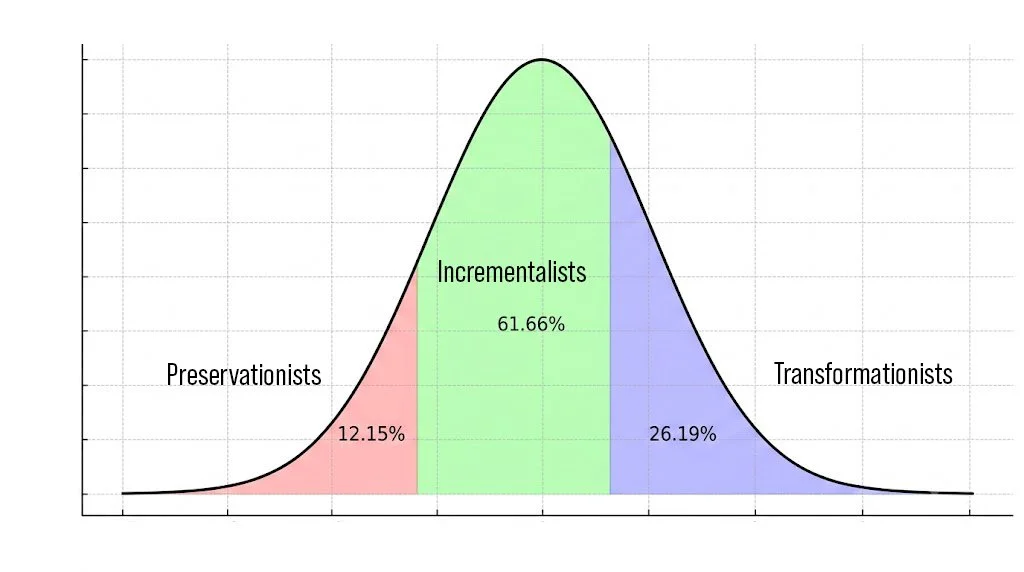
Some caveats: the public opinion poll numbers don’t match the normal distribution proportions – if anything they are more weighted to transformation than average communities – and the public opinion numbers are not yet what the election outcome will be. But we are talking here about the mood of the electorate, not the composition of parliament.
In the preservationist zone sits NZ First – polling at an average 12.15%, acting as an institutional anchor, wanting to freeze cultural and economic shifts, appealing to a nostalgic nationalism, a return to the self-sufficient good old days where ordinary Kiwi blokes worked in extractive industries, and raced around the country in their Holdens going hunting, fishing and to the races. The selection of discarded MPs and a former All Black captain a manifestation of this nostalgia. For a certain segment of the electorate, preservation is the progress they are looking for.
In the centre are the incrementalist major parties – National and Labour, with combined average polling of 61.66 per cent – collectively offering a variation of ‘competent national administration.’ Despite their oppositional rhetoric towards each other, their underlying operational models and goals are deeply convergent. They are both chasing jobs, economic growth, stable tax bases, home ownership and functioning public systems. They compete over who is the safer pair of hands to steer the ship of state within the existing boundaries, offering incremental tweaks, regulatory adjustments, and baseline financial management. Their focus is on efficiency and responsibility rather than innovation. For voters who value institutional stability, this aggregate block represents a comfortable status quo.
On the right side sit the transformationist parties – the Greens, ACT, Te Pāti Māori and Opportunity – collectively polling at an average of 26.19 per cent. These are the parties explicitly declaring that the state is fundamentally broken and can no longer be managed out of its decline. The choice for voters is not whether they want transformation, but which specific flavour they prefer: environmental, constitutional, libertarian or technocratic (see table below).
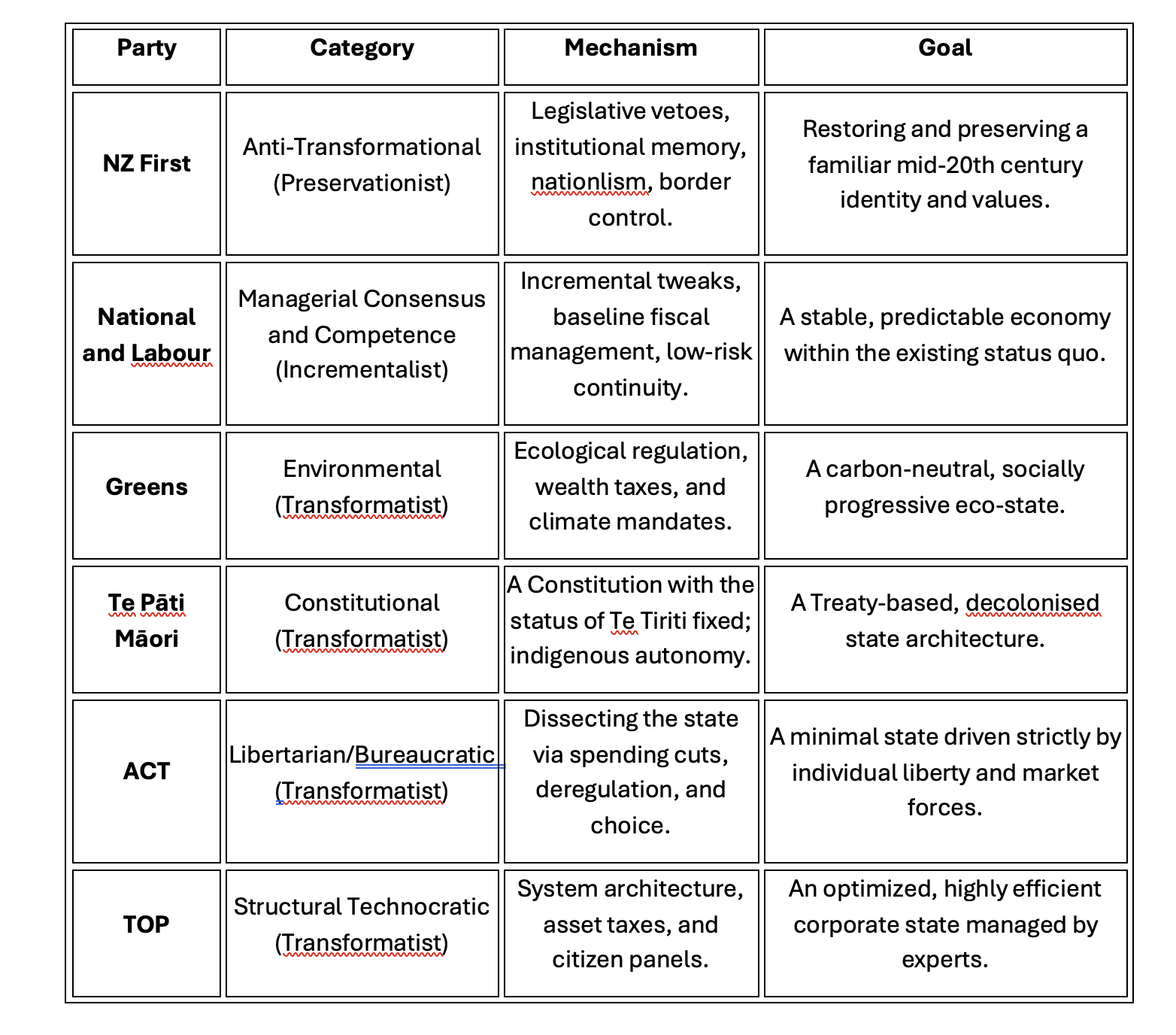
What choice for the majors?
Assuming neither major party is going to pull a rabbit out of the hat between now and the next election – or the election after that – and miraculously increase its support to close to 50 per cent again, the major parties have three broad options available to them if they want to avoid suffering the fate of their UK and Australian counterparts and lose yet even more ground to the minor parties:
1. The Grand Coalition: National and Labour merge, reach the well-over 60 per cent they need, and carry on as before with no minor party to answer to. Not popular with either major party, the risk is it could also last only a few cycles and then suffer the fate of the current majors: uninspiring policies that fail to meet the needs of the dissatisfied 26 per cent of voters who want more, and the 12 per cent who want less.
2. Keep incorporating edge parties into formal coalitions: We have just seen firsthand how difficult this is. Adding parties together to reach a mathematical majority doesn’t automatically create a thriving government. National tried to bring a preservationist party and a transformationist party into the incrementalist tent, naively hoping the numbers would add up to greater managerial competence. Instead, the preservationist side has led sabotage from within. And the transformationist side has struggled to conform to the status quo it now helps run, because friction with that status quo was part of its very offering. Caught between both poles, National has struggled to look like a competent manager at all, and its low poll ratings are a symptom of this.
3. Intellectual Property Acquisition: The major parties keep tweaking and recycling policies that have been on their agendas for decades, hoping that a new leader will make the difference to their success – the classic definition of insanity. The corporate world understands, however, that the easiest way to neutralise a rising competitor is to acquire their intellectual property. To meet the needs of almost 40% of the electorate, the major parties should be treating the margins as a garden from which to harvest the next generation of policy. Finding the best policy seeds, fertilising them, and scaling them up. National's recently updated KiwiSaver policy is a rare example of this dynamic in action; it shares distinct similarities with New Zealand First's retirement savings proposals and has been well-tested by Australia's superannuation system. By absorbing the minor parties' most popular ideas, the majors won't be feeding the minor party's existence (which they are afraid of doing) – they will be undermining their reason to exist.
Yes, this reads like brutal corporate cannibalism when the ‘nicer’ option is to play happy families in messy coalitions. But if the major parties want to be serious about survival, they need to wake up to what voters are telling them. Opportunity’s rise isn't a disruption because of their polling; it’s evidence of voter thirst for a new category of transformation which the incumbents haven't yet stocked on their shelves.