Labour should win in 2026. But should it?
In this column I ask the question that Labour's strategists would rather not sit with: would it actually be a disaster if Labour did not win the party vote in 2026?
The Context
For the first time in New Zealand's electoral history, the opposition Labour party is leading a first-term National party in government in election-year polls by 33.44% to 31.58%. The margin is tight — just 1.86 percentage points averaged across all public polls since 1 January 2026 — but the consistency is what matters. Labour has held a lead since May 2025.
Add the Greens' support of 10.51% to Labour's figures, and the combined left bloc has averaged 43.95% since January — a significant 4.83-point lead over the natural parties of the right. National and ACT, together, can only muster 39.12%. This lead is enough to give Labour and the Greens first claim on forming a minority government.
Minority government is not something we talk about a lot in New Zealand. Yet it is how mature proportional representation systems routinely function. Confidence and supply is negotiated as needed, legislation is tested bill by bill. After the parliamentary abuses New Zealanders have watched from both sides — urgency, insufficient select committee scrutiny, legislation raced through without genuine public engagement — a parliament required to negotiate each piece of new legislation with more than just the parties in government should be welcomed, not feared.
That we are even contemplating such scenarios just over two years into a National-led government is uncharted territory. No modern precedent offers guidance as to what will happen this election year.
The Pendulum That Broke
Until 2017, New Zealand politics operated on a comfortable 9-to-12-year cycle. National would come in and steady the books but would eventually get boring. Labour would inherit a reasonably healthy economy and would get to deploy some innovative ideas. It’s how the country made steady economic and social progress across a 15-to-18-year arc.
As I wrote two weeks ago, New Zealand First broke that pendulum in 2017. What followed has been a series of lurching overcorrections that has served Winston Peters' political interests far more than voters'. Labour's box-seat position in 2026 needs to be seen as the latest lurch, not evidence of a structural realignment toward the left.
These overcorrections have a natural expiry date. Once New Zealand's oldest parliamentarian steps back from leading his party, NZ First will be a shell of its former self. The electoral battleground will look entirely different, and more stable, predictable electoral politics should return.
In the meantime, there’s an election Labour needs to prepare for.
What the Numbers Actually Say
At its current 33.44%, Labour is tracking toward roughly 950,000 party votes. To reach 40% — the party vote threshold it needs to reach to form a government with the Greens without needing to call on NZ First — Labour needs approximately 194,000 additional voters. Spread across New Zealand's 71 electorates, that is around 2,700 people per electorate. In electorates where roughly 40,000 votes are cast, that is a number Labour's normally superior ground game makes within reach.
National's task is harder. To reach the same threshold it needs to find 238,000 more voters — 3,354 per electorate. On its current trajectory, that looks implausible without the economy suddenly starting to boom— low inflation, better wages, rapid house price rises, the building sector humming, young people and families staying in New Zealand.
The odds favour Labour.
Labour Is Baiting but not Converting
Labour's current strategy appears to be all about baiting National into defending its broken cost-of-living promises, then letting the government exhaust itself explaining. And Labour has National rattled. As I wrote last week, National is spending considerable energy giving Labour free publicity, framing the coming election as a referendum on Labour's past rather than a case for National's future.
Labour’s Chris Hipkins is also out-performing National’s Christopher Luxon on the issue that matters most to voters after the economy: leader likeability, which can shift the total party vote by 2 to 4 percentage points. Hipkins is more verbally articulate, on top of a wider range of policy issues and more instinctively political than Luxon. Labour Finance Spokesperson Barbara Edmunds is similarly keeping National’s Nicola Willis in response mode.
And yet Labour is still sitting in the low 30s, when the conditions justify the late 30s. Something is not converting.
The Problem Labour Won't Acknowledge
The reality is that Labour does not yet have enough to say. It is currently leading by not being National, not because it has something better to offer.
After just over two years in opposition, Labour has not had the time or the bench depth to build genuinely innovative policy that excites more voters. And it cannot count on inheriting fiscal headroom. The deficit needs to shrink before there is anything meaningful to spend, which limits the scale of any incoming Labour government's ambitions from day one.
The problem is already visible. On 2 March, Edmonds posted a video on social media declaring that Labour would ‘build an economy that works for everyone, an economy built on solid foundations, good jobs, affordable healthcare, warm homes, real action on the cost of living.’ These are words Labour has been recycling, in various configurations, since the 1940s. They will not persuade any voter who is not already persuaded.
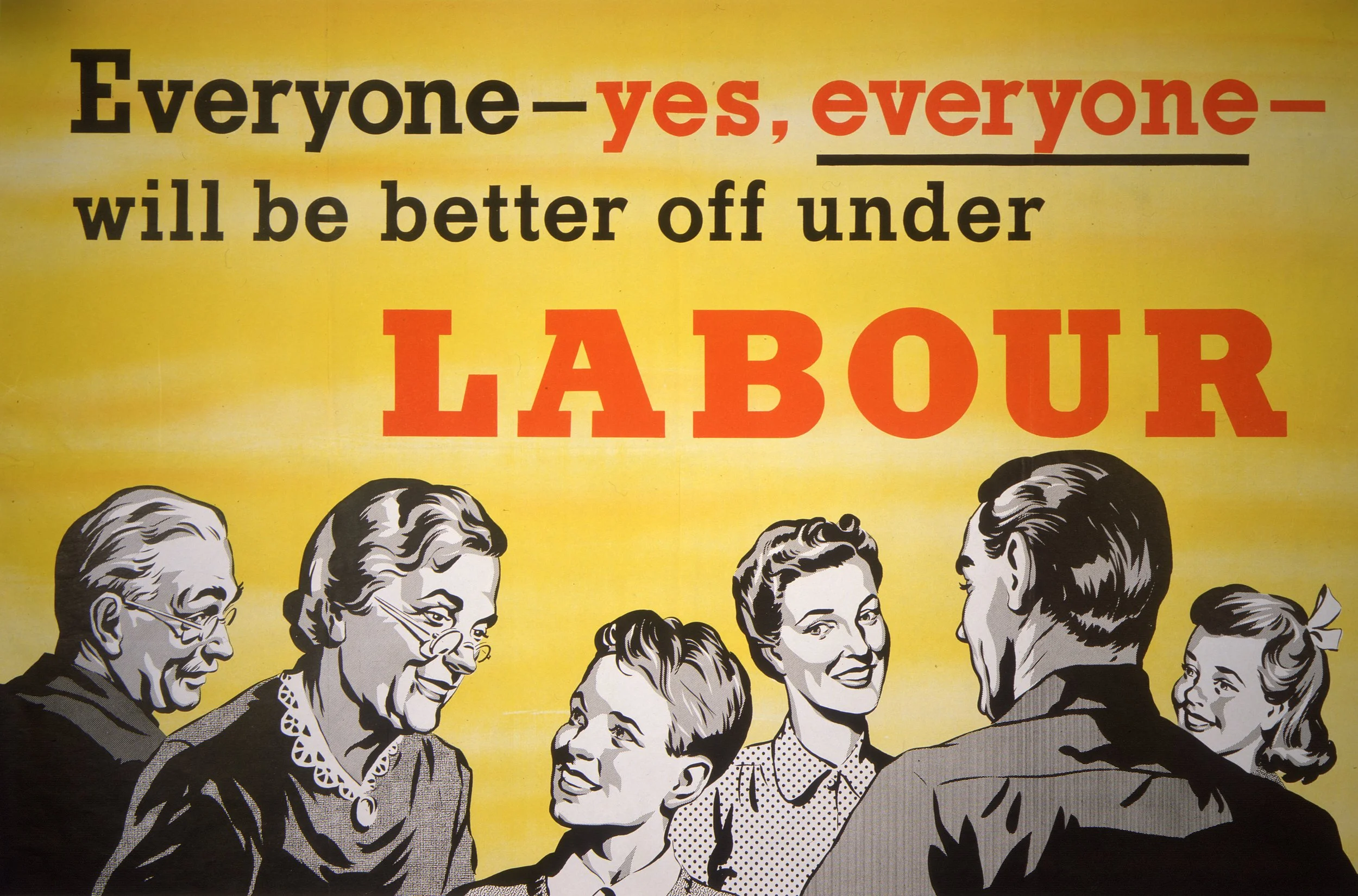
1957 Labour poster
So would it actually be a disaster if Labour did not win the party vote in 2026?
More time in opposition means more time to build policy that is genuinely needed and new rather than cosmetically different. It means more space for the fiscal position to improve before inheriting responsibility for it. And it means time to develop a serious response to the issue that will define the next few decades of New Zealand economic life — and that Labour, of all parties, should own.
The Fiscal Time Bomb
American political commentator Andrew Yang wrote last month about ‘the great disemboweling of white-collar jobs.’ AI is now replacing office workers in earnest, competitive pressure means every firm that automates forces its rivals to follow, and the social contract of ‘study hard, get a good job, live a decent life’ is about to be vaporised.
New Zealand cannot sit back and watch from a safe distance.
The impact will land on top of a fiscal time bomb neither major party has solutions to. New Zealand's tax base rests on three pillars: income tax (around 50% of Crown revenue), GST (around 25%), and company tax (around 15%). All three are directly threatened. Fewer employed people means less PAYE. Financially stressed households means less consumption and less GST.
But AI disruption is only one of three problems arriving simultaneously.
The first is demographic. The largely Pākehā workforce that New Zealand's tax base relies on is retiring out of it and not replacing itself. Already Treasury is warning that within the next 40 years the retirement age will have to rise to 72 and/or all tax rates will need to rise by 15.8% and more to compensate. That assumes the workforce remains as skilled as it is now.
Which brings us to the second disruption: skills. We do not have a skilled Māori and Pacific working-age population prepared to replace the skilled Pākehā workforce. Generations of underinvestment in Māori and Pacific education, workforce and business development mean these communities are not yet positioned to step up — and the current government has dismantled many of the programmes designed to change that.
Now add AI. The white-collar roles a more skilled Māori and Pacific workforce might have stepped into are precisely those most exposed to automation. The ladder is being pulled up just as the people who most need it are approaching the bottom rung.
Together they represent the biggest structural threat to the New Zealand economy in decades.
This issue belongs, by history and by values, to Labour.
What Labour Must Do
Stop recycling empty slogans. These will not win votes outside the base.
Be honest about the fiscal triple threat. No serious party can govern New Zealand over the next decade without a plan that addresses all three. Labour should be the first with a workable answer.
Reframe Māori and Pacific workforce investment as fiscal policy, not social policy. It is not a cost. It is the most important economic investment New Zealand can make. Labour should say so unapologetically.
Play the long game if necessary. By 2029, New Zealand First will likely be spent. A Labour party that uses the intervening years to build something genuinely new will be far better placed than one that scraped into government on 33% with nothing bold to do and no money to do it with.
Next week: ACT came to government to shrink the state. Instead it shrank National's polling.