ACT came to government to shrink the state. Instead it shrank National's polling.
If you have been following these columns, you know this is an unusual election year. The normal rules of New Zealand politics are not behaving as predicted. Last week it was Labour under the microscope. This week it is ACT's turn — and the story is more mathematically interesting than most commentators have noticed.
ACT is a follower party. It may occupy the far right of the political spectrum with its niche libertarian economic philosophy —small state, free markets, people left alone to make their own decisions and live with the consequences—but its real power lies not in its ideology. It lies in its relationship with National. ACT's survival, influence and impact depend entirely on the National party leading the government.
Which makes the numbers that follow rather alarming for everyone on the right.
The Mathematics of Mutual Destruction
Here is what the electoral history of the MMP era actually shows.
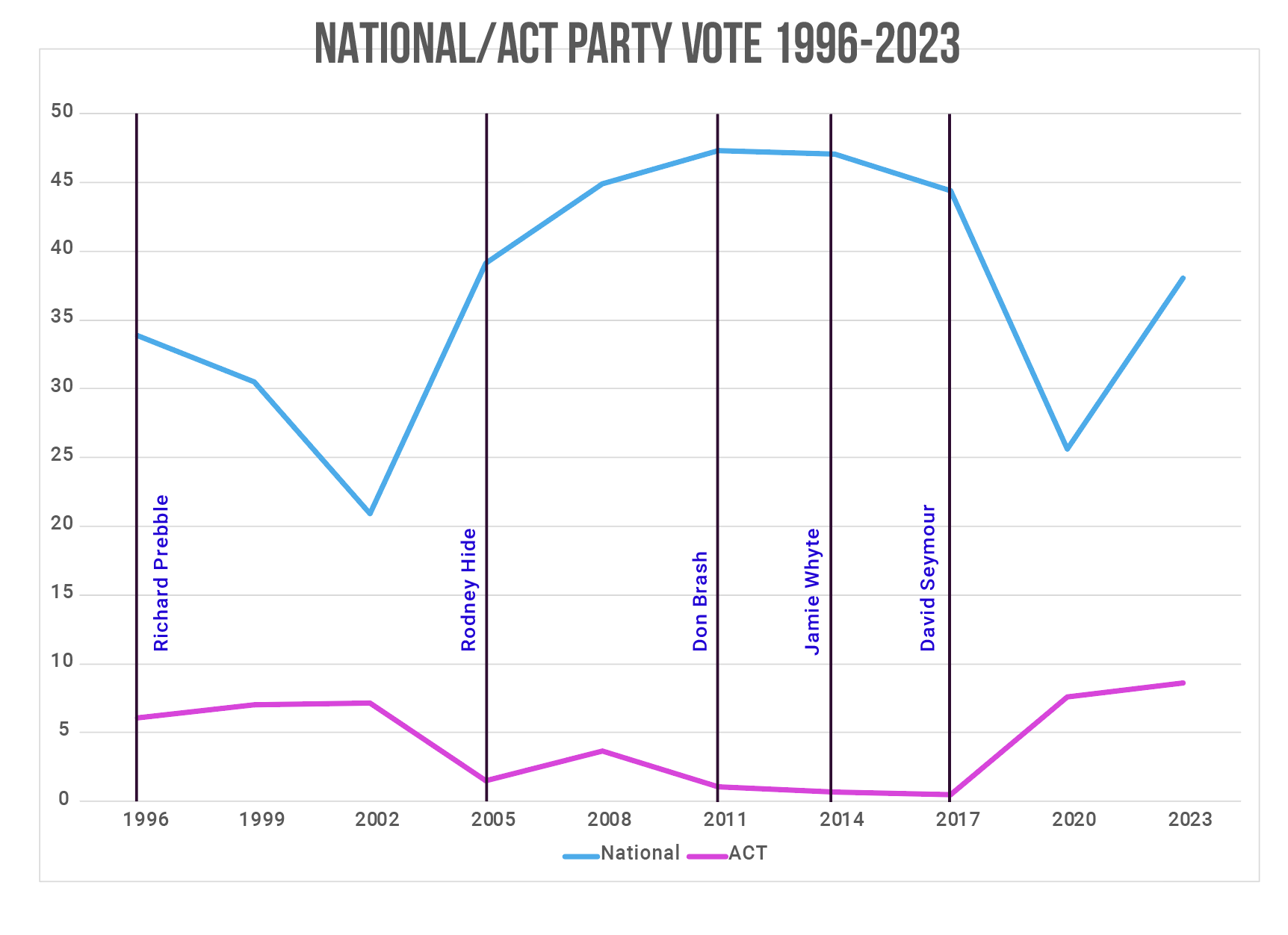
When National does well, it cannibalises ACT's vote. In three of National’s four highest polling elections ACT couldn't make it past 1.07% of the party vote.
When ACT does well, it cannibalises National's vote. In three of the four elections where ACT scored above 7%, the combined right bloc never exceeded 37.54% — 28.07% in 2002, 33.20% in 2020, 37.54% in 1999. In every one of those elections, National and ACT ended up in opposition together.
Chart One shows the relationship between the two party’s party votes from 1996-2023.
Chart Two is drawn from the New Zealand Election Study and shows the late deciding voter preferences for the two parties between 2005 and 2023. Late deciders are those who leave it to the campaign period to make their mind up.
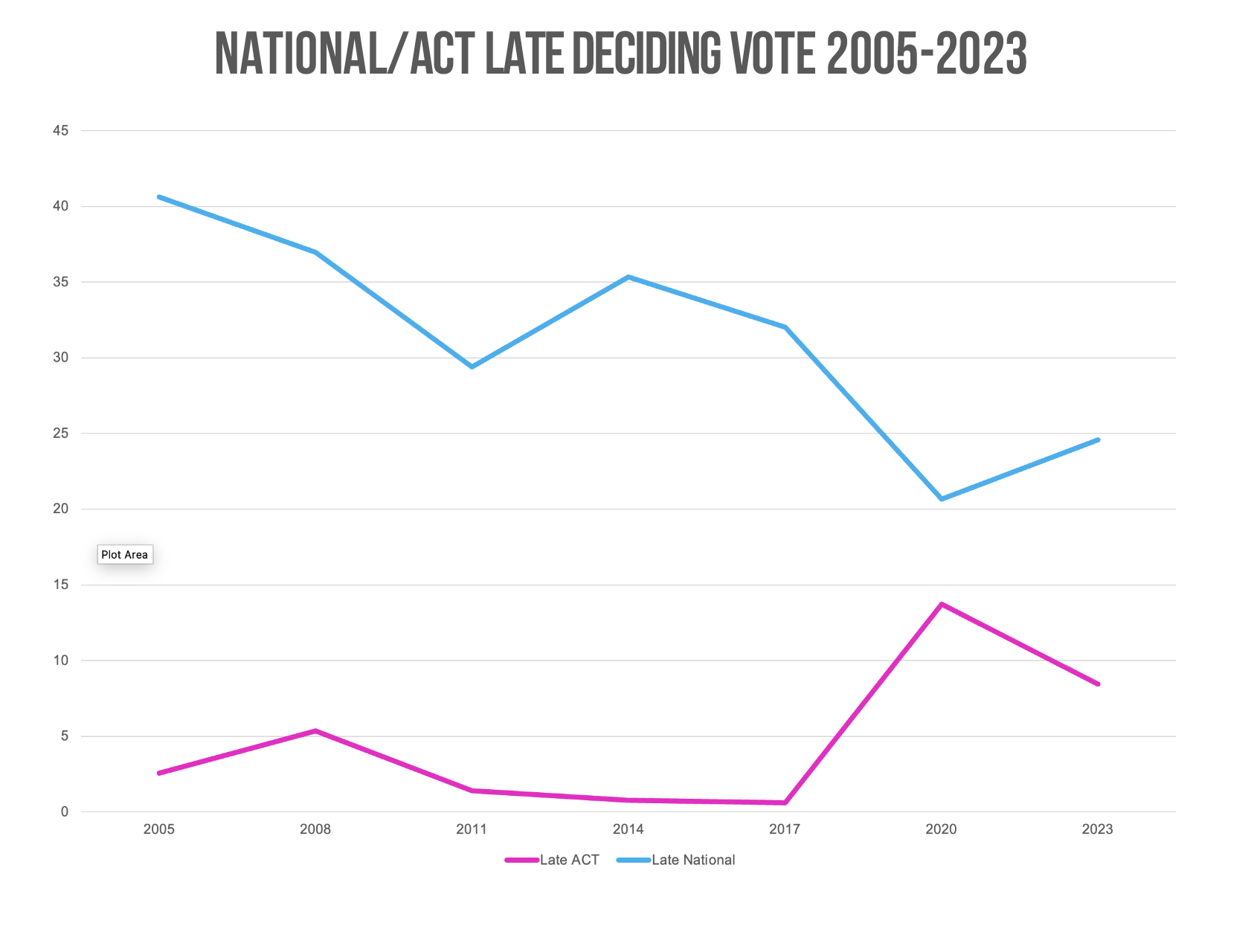
The pattern is consistent. The Right bloc has a relatively fixed pool of voters (as does the Left). When ACT takes more of them, National takes fewer. They are not building the pie. They are eating each other's lunch.
The underlying mechanism is strategic voting. When voters feel their preferred major party needs their support to win, they vote sincerely for that party. When they doubt it, they make a protest vote, sending a message of dissatisfaction while hedging their bets. ACT is, among other things, a receptacle for National's dissatisfied voters.
The outlier was 2008. ACT rode the coattails of the massive swing toward John Key's National, lifting to 3.65% while National reached 44.93%. Together they achieved 48.58% — the highest combined Right bloc total in the MMP era.
Some might argue 2023 was another sweet spot. Both parties lifted from their 2020 lows. National received 38.08% of the party vote, up from 25.6% in 2020. ACT received 8.64%, up from 7.6%. Their combined party vote was 46.72%, up from 33.2% in 2020; the fourth highest right bloc total in MMP history.
But look more carefully and 2023 was already a warning. National's 38.08% was respectable but well short of its Key era dominance and comfort. 2023 swing voters knew they did not want another Labour government but were not yet fully sold on National as the alternative. Far right-leaning protest votes went to ACT. Centre-right protest votes went to New Zealand First. The result was a coalition that looked strong on paper but rested on a fragile foundation, as the polling of the past eighteen months has confirmed.
What 2026 Is Already Telling Us
ACT's vote is currently averaging 7.54% in public polls. In isolation that looks like good news for the Right. In historical context it is an ominous sign for National. The voters ACT is holding are voters National is not getting, and National cannot afford to lose them.
National is sitting at 31.58% and still falling. Its polling shows no signs of bottoming out. The reasons voters shifted to National in 2023 — frustration with Labour's economic management, the promise of cost-of-living relief — have not been delivered on. Luxon's preferred Prime Minister ratings are in decline. And external conditions are worsening: with the US-Iran conflict squeezing global oil prices and supply, inflation is forecast to rise toward 3.7%, threatening to erase the government's remaining economic credibility argument just as the election approaches.
If ACT holds above 7% and National cannot arrest its slide toward 30% or lower, the historical pattern points in one direction. A combined right bloc below 38% puts a repeat of this coalition government out of reach, regardless of how well New Zealand First does.
ACT's current success, in other words, may be yet another indicator that the right is heading for opposition.
ACT's Tactical Dilemma
Which brings us to ACT's central problem for 2026.
ACT has worked hard for its 7.54%. It has maintained its base, dominated social media and kept its leader prominent. His abortive attempts to change the meaning of the Treaty of Waitangi aside, David Seymour is one of the most fluent parliamentary debaters of his generation. He is quick, ideologically sharp and genuinely funny. He seems to enjoy being a politician and doesn’t mind making a fool of himself in public. His deputy Brooke Van Velden is so dry she comes out of the shower and doesn't need a towel! Together they make a formidable team.
The problem is that they make a formidable opposition team. And they are not in opposition.
Every point ACT holds is a point National does not have. National needs to appear dominant and in pole position to win the highest share of the party vote before its voters will return. They want to be sure they’re backing a winner.
Every week Seymour dominates the news cycle as if he is still an opposition minor party leader desperate for each bit of media coverage he can get is a week Luxon cannot use to rebuild his numbers.
ACT is biting the hand that feeds it. Not maliciously, probably not even consciously, but the mathematics are unforgiving. And the conclusion devastating for both parties— another 3, 6, even 9 years in opposition.
There is a tactical solution, which ACT won’t like. Since 2008, National and ACT have maintained an arrangement: party vote National, electorate vote ACT in Epsom, bringing in additional ACT MPs on the coattails of the electorate deal. It has served ACT well for 6 elections. The question for 2026 is whether ACT is now prepared to return the favour — encouraging its supporters to give their party vote to National, sacrificing some of its own polling strength to help the Right bloc reach a threshold that will enable it to remain in government.
It would require ACT to prioritise the coalition's survival over its own result. It would require Seymour to spend seven months making Luxon look good rather than himself.
The maths say the answer is obvious.
David Seymour's high sense of self-worth suggests the choice will be anything but.
Next week: The Greens have been in parliament for 26 years. Name their three most significant policy achievements. Take your time.