Is it time for the Greens to ditch the Dad-vote for good?
The Greens Have Been in Parliament for 26 Years. Name Their Three Most Significant Policy Achievements. Take Your Time.
I put this question to some of the greenest people I know; people who have voted Green for decades, who care deeply about the environment, who follow politics closely. It wasn’t easy. Eventually they identified four: Warmer Kiwi Homes, The Zero Carbon Act 2019 and the Climate Change Commission; The Clean Car Discount; and Ending Offshore Oil & Gas Exploration. Sue Bradford's anti-smacking legislation was sometimes added to the list, but that was an individual member's bill rather than a party win.
Almost all have been repealed or gutted by the current government. Only Warmer Kiwi Homes is still standing.
So what has gone wrong? And why does it matter less than you might think in 2026?
The Structural Problem
The Greens have always faced a major constraint in that Labour does not want to share the left vote. In twenty-six years, the Greens have never been given a formal coalition role with Labour. They have been offered confidence and supply arrangements, ministerial portfolios outside cabinet, and the occasional policy concession, but not a coalition role that would give them genuine decision-making power.
Part of this is down to Labour calculating that keeping the Greens at arm's length protects its own vote share. Part is Green pride. They want to maintain a distinct brand as an independent party rather than being swallowed by Labour. Regardless of which party has driven the choice, the consequence is that the Greens have spent a quarter century as Labour's support act, influencing policy at the margins while Labour takes the credit and the votes.
Policy Drift
The Greens have compounded this by drifting from their founding identity. Founding co-leaders Rod Donald and Jeanette Fitzsimons built the party on clarity of purpose — environmental policy, which they walked as well as talked in both their politics and their personal lives. With every change of leadership since, the party has moved to a broader left-wing social and economic policy platform. In part to increase its voter base. In part because climate change is inseparable from economic inequality; environmental justice is inseparable from social justice.
But it puts the Greens in direct competition with Labour for voters. The expansion has also not solved some of the party's deepest electoral problems. It has simply moved around them.
In the 2023 election, the Greens won 23.97% of the party vote in affluent, student-heavy Auckland Central. Just 23 kilometres away in the industrial heartland of Manurewa, they won 5.86%. That gap tells a lot. When a low-income household is choosing between heating the home and paying the power bill, the Green message about emissions reduction targets and just transitions does not land with the same urgency as promises of cost-of-living relief and tax cuts. The Greens have never been the party of the factory floor, the freezing works or the construction site. They argue for working-class interests without being of working-class culture. They speak for communities they do not fully speak to.
Then there is the Dad Problem.
The February 2026 Roy Morgan poll found the Greens' largest support base among women aged 18-49, where they sit at 24.5% — just one point behind National. Among men over 50, they are languishing in fifth place at 3%, behind the combined 3.5% for ‘other’ parties. The coalition bloc — National, ACT and NZ First — commands 67.5% of the male over-50 vote. Labour and the Greens together manage 28%.
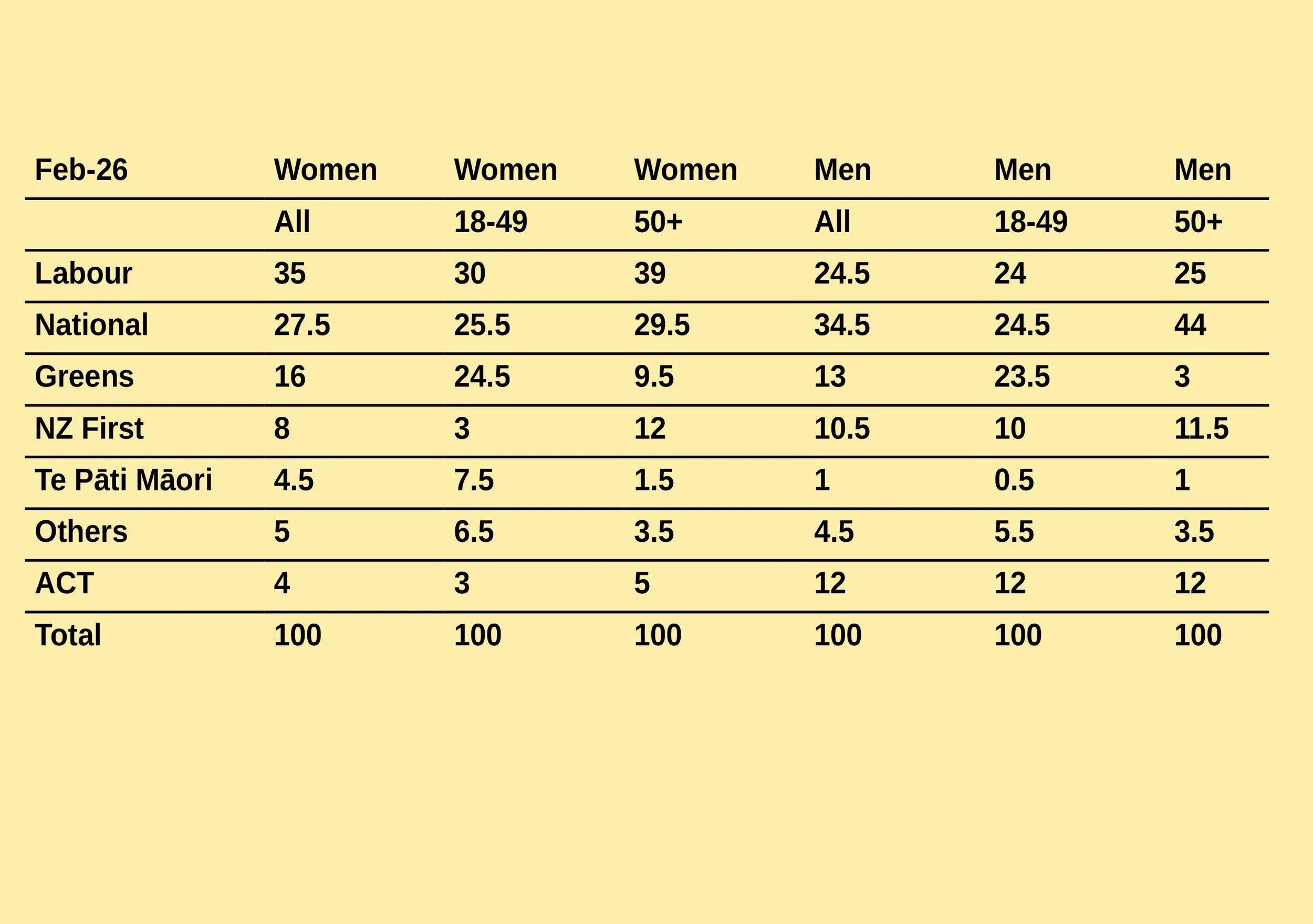
The Greens have tried to close this gap with evidence-based policy. The Green Alternative Budget reads like it is an economic journal article, full of detailed evidence, rigorous costings and data-heavy arguments.
Yet although it is often assumed that men over 50 are more ‘rational’ when it comes to their voting decisions and will objectively respond to evidence-based arguments, yeah nah. Their votes are as much driven by habit, emotion and seeing themselves reflected in their representatives as the rest of the electorate. It is no coincidence that the parties pulling 67.5% of that demographic are the ones whose leaders wear suits to work and polos at the weekend. The Greens are not going to win Dad voters by out-wonking National. They are going to have to find a different language entirely — or accept that the Dad vote is not their territory and focus their growth energy elsewhere.
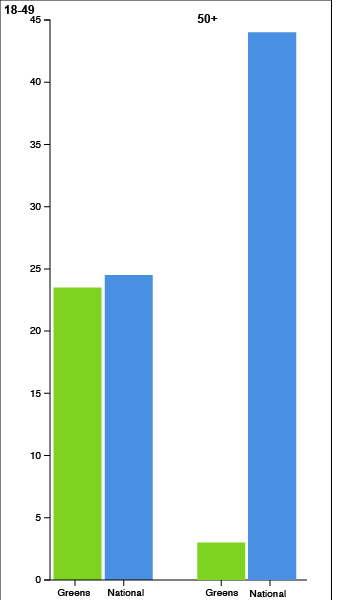
The Dad Differential
As it turns out, they may have found somewhere considerably more interesting to grow.
The Māori Seats
The really interesting story, that one many may have missed, is the direction the Greens are travelling in Te Tiriti space. Here there is a rather large pivot taking place towards Te Pāti Māori’s rohe.
When Teanau Tuiono announced at Waitangi on 4 February that the party would be standing three highly credentialed and respected wāhine Māori — Hūhana Lyndon, Tānia Waikato and Heather Te Au-Skipworth—in three Māori seats in the 2026 election, it was a game changer. The Greens would no longer be politely standing back in the Māori seats to avoid splitting the left vote.
A month later, the Greens released a tentative list with 14 of 37 candidates — 37.83% — identifying as Māori. That is well above population parity and approaching something closer to an expression of sovereign equality.
This is smart politics. The Greens are positioning themselves as the credible Plan B for Māori voters who are frustrated with Te Pāti Māori's increasingly internal focus, who still feel exploited by Labour, who would never vote National, and who have not forgotten NZ First's 1996 betrayal — winning every Māori seat on a platform of change for Māori, then delivering a coalition with National. Under MMP, you cannot promise the world to Māori voters, fail to deliver, and expect loyalty at the next election. Te Pāti Māori is about to learn the same lesson.
There is nothing ideologically dissonant about this pivot. Māori politics and Green politics share deep alignment in their concern for te Taiao — the natural world. Kaitiakitanga and environmental stewardship are not competing values. And as I argued in my column on Labour, the workforce and markets of tomorrow are Māori and Pacific. Any party not planning for that future is going to be left behind. The Greens are signalling they are already there.
The Greens are offering Māori voters sovereignty with stability. They will be hoping their twenty-six years in parliament — and their reputation for principled consistency even when it has been electorally costly — may be exactly the reassurance that makes that combination credible.
Why None of This Explains 2026
Even if they hadn’t made the pivot towards the Māori vote, the Greens were already in a strong position to contest the 2026 election in November.
They are averaging 10.52% in public polls since January — holding their 2023 election result of 11.6% remarkably well. Added to Labour's 33.8%, the combined left bloc sits at 44.32%, a 5.35-point lead over the right bloc's 38.97%.
The Greens are not just surviving. They are one of the highest-polling Green parties in the Western world, having maintained double-digit support through three years of a National-led government and genuine fiscal pressure.
The traditionally stronger German Greens collapsed to 11.6% in the 2025 federal election after a bruising coalition that satisfied nobody. Dutch Greens merged with Labour to survive. Other European Greens have struggled to hold their positions as cost-of-living pressures pushed voters toward economic security over environmental ambition. The outlier is the British Green Party under new leader Zack Polanski, which is polling at 18% — extraordinary in a first-past-the-post system that structurally disadvantages smaller parties. The Green movement has not completely collapsed under cost-of-living pressure. If anything, the Iran conflict and the resulting oil price spike are making the argument for energy transition look more urgent rather than less.
The Green Belt
This week, Green Co-Leader Marama Davidson laid into Chris Bishop and National for the hypocrisy of announcing funding for new public EV charging stations while being the same government that wound back the clean car discount, the clean car standards, and incentives for people to choose EV cars.
It was the Greens back to doing what the Greens do best: holding the government to account on its own contradictions in the one policy area where the Greens have unmatched credibility.
This is the Greens’ sweet spot. It’s not trying to out-Labour Labour on housing or health. It’s not producing twelve-point budgets to impress Dad voters who are really only attracted to men in blue suits. It’s occupying the ground where no other party has the courage to stand; the intersection of environmental integrity, energy security and the economic costs of inaction — and making both major parties answer for the gap between their rhetoric and their record.
The world is finally catching up with the evidence they Greens have been presenting since before most of their current voters were old enough to vote. Every petrol price spike is an argument for the transition they have been advocating for over a decade.
In the unprecedented case that Labour manages to win the majority of the party vote in the 7 November election, it’s highly unlikely they can form the next government without the Greens’ support. Having seen how much ACT and NZ First were able to extract from National in their 2023 coalition agreements, the Greens should be in a good position to demand more than just a token few seats around the cabinet table. 26 years is a long time to apprentice. This could be the year they graduate.
Next week: The Māori Vote, take it for granted at your peril!