Thursday 6 August 2026: A tale of two leaders
Thursday 6 August 2026 will go down in the record books. Not because it was an unusually calm, beautiful Wellington day, but for the stark contrast between two leaders. One putting his foot in it, again, the other not putting a foot wrong.
The future leadership team of the National Party looked relaxed after trekking up to one of the city’s normally windiest spots to make an announcement about nine new industry-related secondary subjects. The release had been brought forward from its scheduled date in an attempt to run some positive news and deflect attention away from the volly of Luxon brain farts that had dominated the news cycle for over a week.
Little did Nicola Willis and Erica Stanford know that at the other end of the island, on Kerre Woodham’s NewstalkZB podcast, Christopher Luxon was sabotaging their good news day with his foolish commitment to revisit MMP.
Much has already been written about how Luxon blind-sided his caucus colleagues, lacking the self-awareness to not commit the government to a policy that was not a policy. When an average 39% of the electorate is signalling they want a party that is not National or Labour, that’s not a sign to review MMP. That’s a sign that almost half of the electorate likes MMP. In a blistering weekend column, the NZ Herald’s Thomas Coughlan described Luxon as ‘a man who cannot exert control over the few inches between his brain and his mouth.’
To this I would add his blindness on constitutional matters. Minutes before the gaffe he wheeled out one of his favourite lines – I'm not a career politician – his standard excuse for not knowing the rules (despite being in parliament almost six years.) Then he said he was ‘quite right to check in constitutionally, and say, is this the system New Zealand still wants.’
Luxon may have thought using the word ‘constitutionally’ made him sound informed. It did the opposite. There’s no such thing as a constitutional check-in. Constitutions exist to protect citizens from random check-ins.
Constitutional protection
Constitutions establish the rules of the electoral system, define what governments can and cannot do, and protect certain rights from interference. In any healthy democracy they are meant to be fixed hard in concrete, separated and protected from alteration by sitting governments and unpopular Prime Ministers riffing their unformed thoughts on a radio podcast.
The situation is not helped by New Zealand being one of only a handful of countries without a codified constitution. This does not mean we have no constitution. It means it is informal and scattered, spread across acts of Parliament, court judgments, inherited conventions, the Cabinet Manual, the Letters Patent that establish the Governor-General's role, Parliamentary Counsel guidelines and a handful of other sources.
The standard defence for why we do not have a codified constitution is that we do not need one. Over nearly two centuries New Zealand has passed statutes – the Constitution Act 1986, Electoral Act 1993, and New Zealand Bill of Rights Act 1990 – to adjust the informal constitutional framework as society has changed, rather than rewriting a master document. Such a patchwork, it is claimed, delivers flexibility, stability and democratic accountability, making a rigid written constitution unnecessary.
But this casual approach carries democratic risks. When a government, or in this case a rogue Prime Minister, begins treating winning an election as conferring not merely the right to govern but to publicly muse about changing the very rules that are meant to bind whoever governs, it is the antithesis of constitutional. It is an abuse of power.
Treaty of Waitangi
Of course, the real reason New Zealand doesn’t have a formalised constitution is te Tiriti/ the Treaty of Waitangi.
To write a single constitution, Parliament would have to acknowledge the Treaty as the authorising document that constituted the New Zealand state more than a decade before the New Zealand Parliament existed, making the Treaty superior to ordinary legislation and untouchable. That has consequences for the exercise of political power, which I take up in my forthcoming book, Stolen Sovereignty: The Untold Story of Parliament and Māori.
If Luxon is serious about producing a constitutional check-in, it should be to formalise a constitution with the Treaty at its centre, not a tinkering with the rules of the electoral system.
The face doesn’t lie
Which brings us back to Willis and Stanford at the Mākara windfarm on 6 August.
On Saturday, Thomas Coughlan posited that Erica Stanford ‘is said to have come around in favour of a change of leadership – with herself at the top of the ticket’ – a suggestion she quickly dismissed. Naturally. If she is to roll Luxon it would not be by telling the press on the same day that National’s list is announced.
But Willis’s face on 6 August told otherwise. It’s hard to find a still news image of that day where Nicola Willis isn’t beaming, comfortable in the knowledge that the ever prepared and on top of her subject matter Erica Stanford was never going to put a step wrong. Willis wouldn’t be left grimacing, digging her out, explaining her comments away, pretending there is nothing to see here as she normally is when she’s standing beside or behind Luxon. Stanford and Willis looked very much like the next National leadership team in waiting.
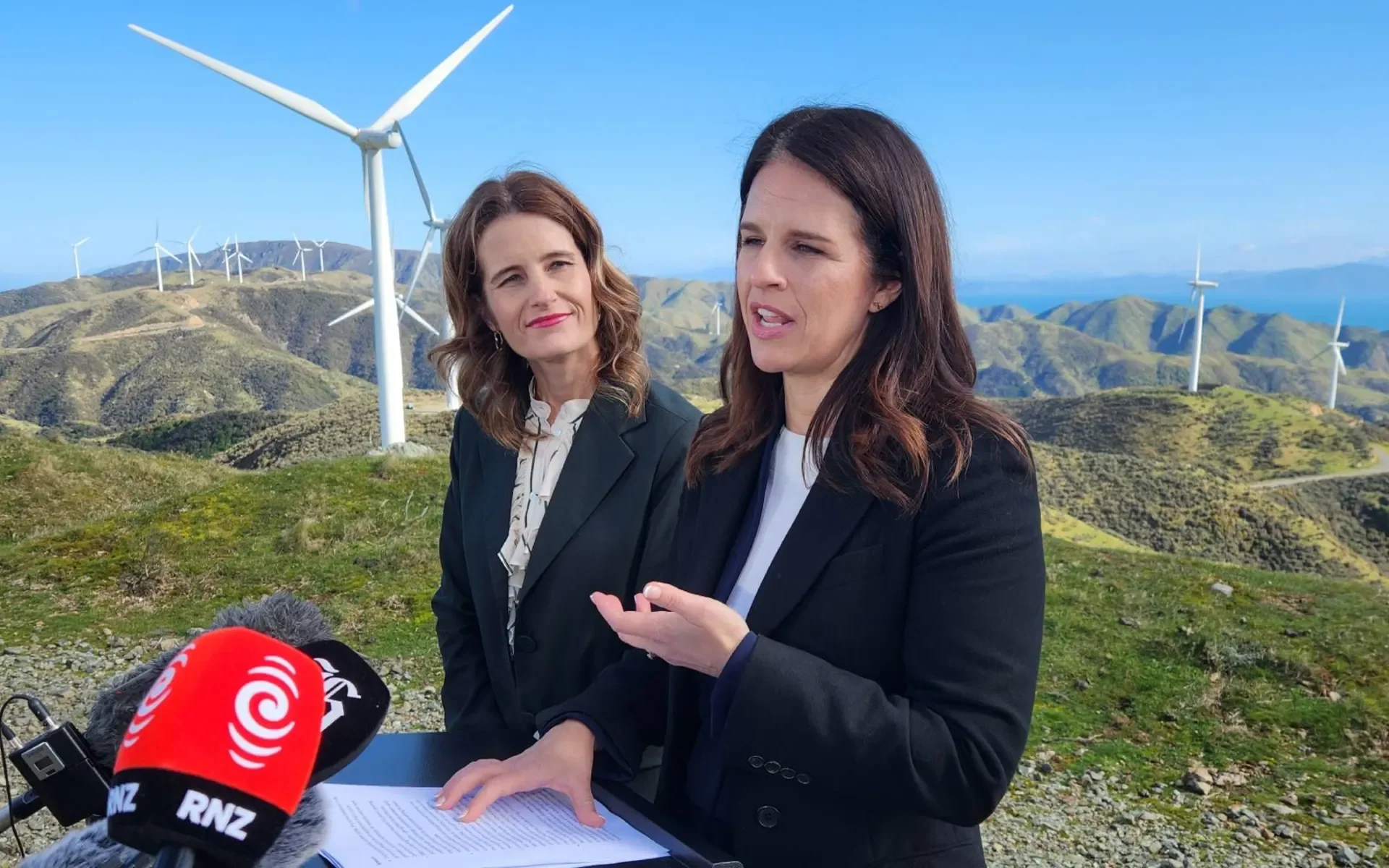
RNZ/John Gerritsen
Like Jacinda Ardern before her, Stanford may not yet be tested on portfolios outside her immediate expertise and interest. But as Ardern proved, there is never a perfect moment to step up.
6 August 2026 was meant to be National's good-news day. Instead, it became a tale of two leaders – and perhaps a glimpse of the party's next one. Luxon may have thought he was casually testing the constitutional waters, when all he really did was test his party’s patience to breaking point and accelerate Stanford’s rise.