The Target Trap and Treaty Principles
The ‘target trap’ is a term for when a Minister becomes so entirely consumed by ticking a specific KPI box to satisfy a political leader’s instructions they set aside meaningful policy deliberation, robust legal scrutiny, and proper public engagement in favour of solutions that meet an arbitrary political date. The solutions rarely stand up to real-world pressure and carry many unintended downstream consequences.
Economists have various names for this. Goodhart's Law holds that when a measure becomes a target, it ceases to be a good measure. Campbell's Law observes that the more a quantitative indicator is used for decision-making, the more it will be manipulated, distorting the very processes it was meant to monitor. Then there’s the Cobra Effect – where incentives designed to solve a problem end up rewarding people for making it worse.
The need for speed over better outcomes has its perfect champions in Christopher Luxon and Paul Goldsmith. Luxon’s political brand is built entirely on quarterly action plans, rigid portfolio swim lanes and ministerial KPIs designed to enforce speedy execution. Goldsmith is one of the National party’s most loyal servants. For fifteen years he has obediently followed his masters’ orders, sitting back in five consecutive elections to allow ACT candidates John Banks and then David Seymour win what should be Goldsmith’s Epsom electorate. As Minister of Justice in the current coalition he has dutifully raced through KPIs like his piano playing hands are stuck in permanent prestissimo.
But while the Prime Minister’s relentless focus on delivery may work for shifting metrics like ED wait times and increased student attendance, it collapses when applied to constitutional determinants like the Treaty of Waitangi. Constitutional lawmaking demands a much higher threshold of scrutiny than meeting KPIs fast.
The target
For the past twenty-one years the New Zealand First political party has been trying to have the words ‘principles of the treaty’ removed from legislation. Winston Peters wants to put an end to the expensive and never-ending legal programme that has sprung up around the principles and resulted in an endless stream of ad hoc policies at a cost of millions of taxpayer dollars that he says have delivered nothing for Māori.
Twice Peters tried to achieve this through his own legislation, in 2005 and 2007. Neither Bill gathered sufficient support in the House to pass. While the principles may not be perfect, previous major party leaders have understood them to be more adaptable than the Treaty articles. By acknowledging the principles, parliament can continue legislating without the disruption that addressing its history of article avoidance would cause.
Undeterred, New Zealand First shifted to another tactic in 2023. Rather than create specific legislation and risk it being voted down a third time, it inserted into the National/NZ First coalition agreement a government commitment to comprehensively review all [standard] legislation that includes ‘the Principles of the Treaty of Waitangi’ and replace all such references with specific words relating to the relevance and application of the Treaty, or repeal the references.
That review has now been completed and Paul Goldsmith announced on 15 May 2026 that the Government had agreed to amend two references to be more specific, repeal seven references, and specify no higher standard than to ‘take into account’ in provisions to the Treaty of Waitangi across ten acts. This was ‘to ensure references to the principles of the Treaty of Waitangi are clear and consistent’.
Reducing the Crown’s commitment to the Treaty to being something it needs to simply take into account (and can then ignore) as opposed to honour or give effect to, is a monumental shift in the role and interpretation of the country’s founding document. Though you wouldn’t know it to look at the government’s last October 2025 quarterly plan, where this legislation was euphemistically reduced to the words ‘Treaty matters’. A matter being just another topic – something to be managed, audited, and ticked off before the 2026 election.
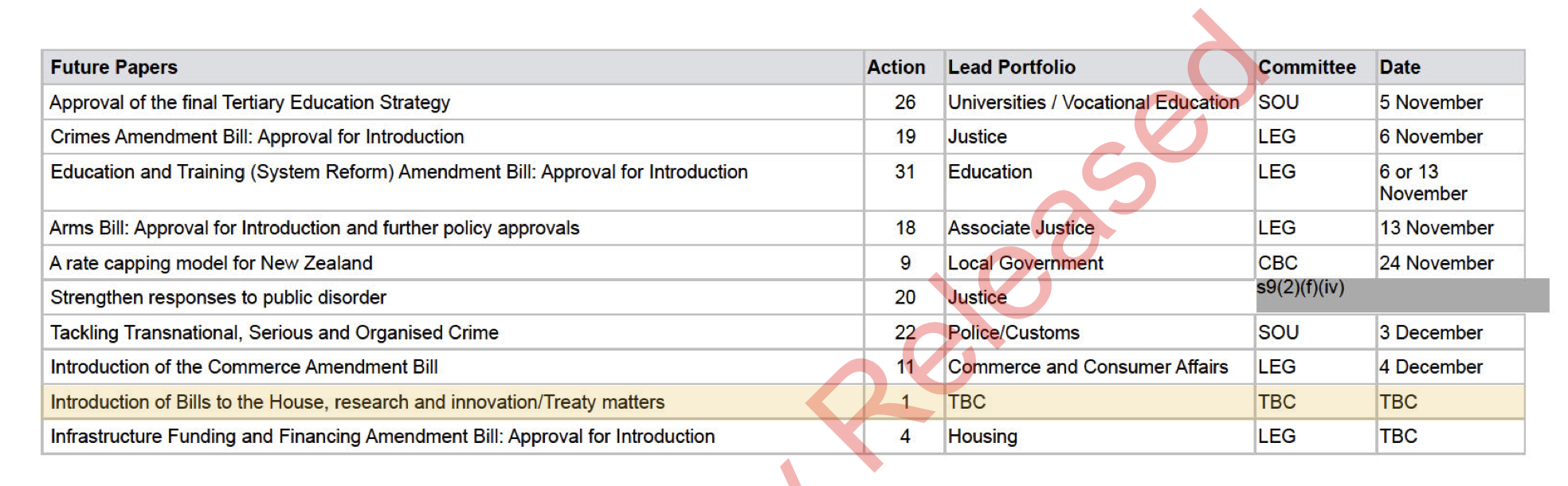
The constitutional risk in reducing treaty principles in legislation to a clinical, quarterly checklist matter was laid bare last week when Secretary for Justice Andrew Kibblewhite and his Deputy Secretary Policy Caroline Greaney submitted a joint brief of evidence to the Waitangi Tribunal as part of its Te Tinihanga o Ngā Mātāpono o te Tiriti – the Treaty Principles Reform Urgent Inquiry.
The 31-page brief of evidence gave an overview of the policy and Cabinet decision-making process for the review of references to the principles of the Treaty of Waitangi in legislation. It was accompanied by 385 pages of supporting documents covering the period from late 2023 to May 2026.
The brief describes ministerial decisions in procedural terms – directions given, papers approved. But it also tells the story of a Minister of Justice who drove a faster timeline than officials recommended, removed iwi engagement from the process, replaced Treaty expert advisers with a broader interest group, made the most substantive policy decision in the review verbally and against specific advice, and declined to act on Waitangi Tribunal findings. All in the interests of appeasing Winston Peters and getting this matter ticked off before the 2026 election.
Um no, you can’t do that
Understandably, the Waitangi Tribunal, dozens of law firms, hundreds of iwi, hapū and other Māori claimants, and tens of thousands of informed New Zealanders have thrown their hands up in horror. All know the move is so blatantly unconstitutional and in breach of the Treaty that it will be impossible for the Tribunal to rule anything but that. The government’s need for speed is being reciprocated by the Waitangi Tribunal which is holding an urgent hearing into its urgent enquiry into the government’s ‘reform’ this coming week.
At the end of last week Goldsmith wrote two memos in response to the outcry. The first to the Iwi Chairs Forum on 27 May 2026, in which he indicated that standardisation was ‘a starting position’. The government was still considering the best approach to some of the Treaty principles references, and the select committee process was the forum for this to be worked through. The second memo was to the Waitangi Tribunal on 28 May 2026. In it he explained his decisions to date were ‘political in nature and a product of political process’. But there was still scope for parliamentary processes to influence final decisions.
Both documents are classic political deflection. Admitting the matter is political (in other words in the coalition agreement) and so has to be dealt with quickly is no justification for unilaterally ignoring proper process. The Treaty is owned by two parties: the Crown (a separate entity to the government) and Māori. Proper constitutional process requires the government, as representative of the Crown, to seek agreement from Māori prior to any legislative changes to how the Treaty is interpreted. The Select Committee process is not an adequate substitute for engaging with the other signatory to the Treaty of Waitangi on any change to how the Treaty is officially recognised by Parliament.
Political football
Sadly, in the absence of a formalised written constitution that protects the Treaty, the Crown-Māori relationship has become a political football, available to be traded, legislated away or redefined by an elected majority for the acquisition of power in the political market.
Which is precisely the problem. The lack of clarity and consistency Goldsmith refers to is not caused by the proliferation of Treaty principle clauses. It is caused by the absence of a constitutional foundation that fixes the Treaty's articles in stone and renders them unavailable for parliamentary reinterpretation every time a new coalition negotiation requires it as currency.
If there’s any discussion that needs to be expedited by Luxon and his quarterly targets, it is the constitutional one.
The Cobra Effect
The unintended consequence of the target trap Goldsmith fell into when his boss required him to sort out this matter before the 2026 election will be that this is anything but sorted. A hurried, low-engagement process ensures that the Treaty principles reform remains an open, volatile constitutional wound that will dominate the legal system and political landscape long into the government’s next term (if it gets re-elected). If legislation is changed, it will invite more, not less, litigation, pushing the question of what ‘taking into account’ means back to the courts that governments think already overreach their mandate on the Treaty. With forty years of treaty jurisprudence to refer to, the courts are unlikely to be as constrained in their reading of the Treaty as they were back in 1987.
Winston Peters spent twenty-one years trying to remove Treaty principles from legislation because he believed they had created legal chaos. By racing to satisfy Peters' coalition demand on an arbitrary electoral timeline, Goldsmith has not ended that chaos. The measure became the target, the target corrupted the process, and the incentive to deliver fast has rewarded the outcome it was designed to prevent.
Peters wanted fewer lawyers arguing about the Treaty. Goldsmith is handing him more.