Competitive Myopia, Fighting Ghosts, Protecting Frenemies
Last Friday the Taxpayers' Union released an ad in which an AI-generated Chris Hipkins bursts into a family home at dinner time, sweeps the wallets and phones off the table and moves next door. There he snatches a woman's handbag while she watches television. The target is Labour's capital gains tax, a "money grab on our nest eggs". Setting aside the ethics of casting the Leader of the Opposition as a home raider, the better question is who exactly is the ad meant to persuade?
I’ve done four different interviews over the past fortnight on the debates and the campaign so far (listed below). In all of them I have said both National and Labour are mistargeting their campaign efforts. The TPU can now be added to this list. All are acting as if Labour and National are each other’s primary competition. The reality is that neither will find many new voters in the other's camp.
A ghost segment
The New Zealand Election Study asks voters when they reached their voting decision. Across the last three elections, an average of 65 percent of National and Labour voters did so before the campaign began. Another 21 percent decided during the campaign but before the last week. That locks in about 86 percent of each major party's vote before the final week (see chart below).
Only about one in seven major-party voters decides in the last week or on election day. Fewer still are weighing a straight swap between National and Labour. A major party (or third party supporter) that spends the campaign attacking the other major party is aiming at a ghost segment.
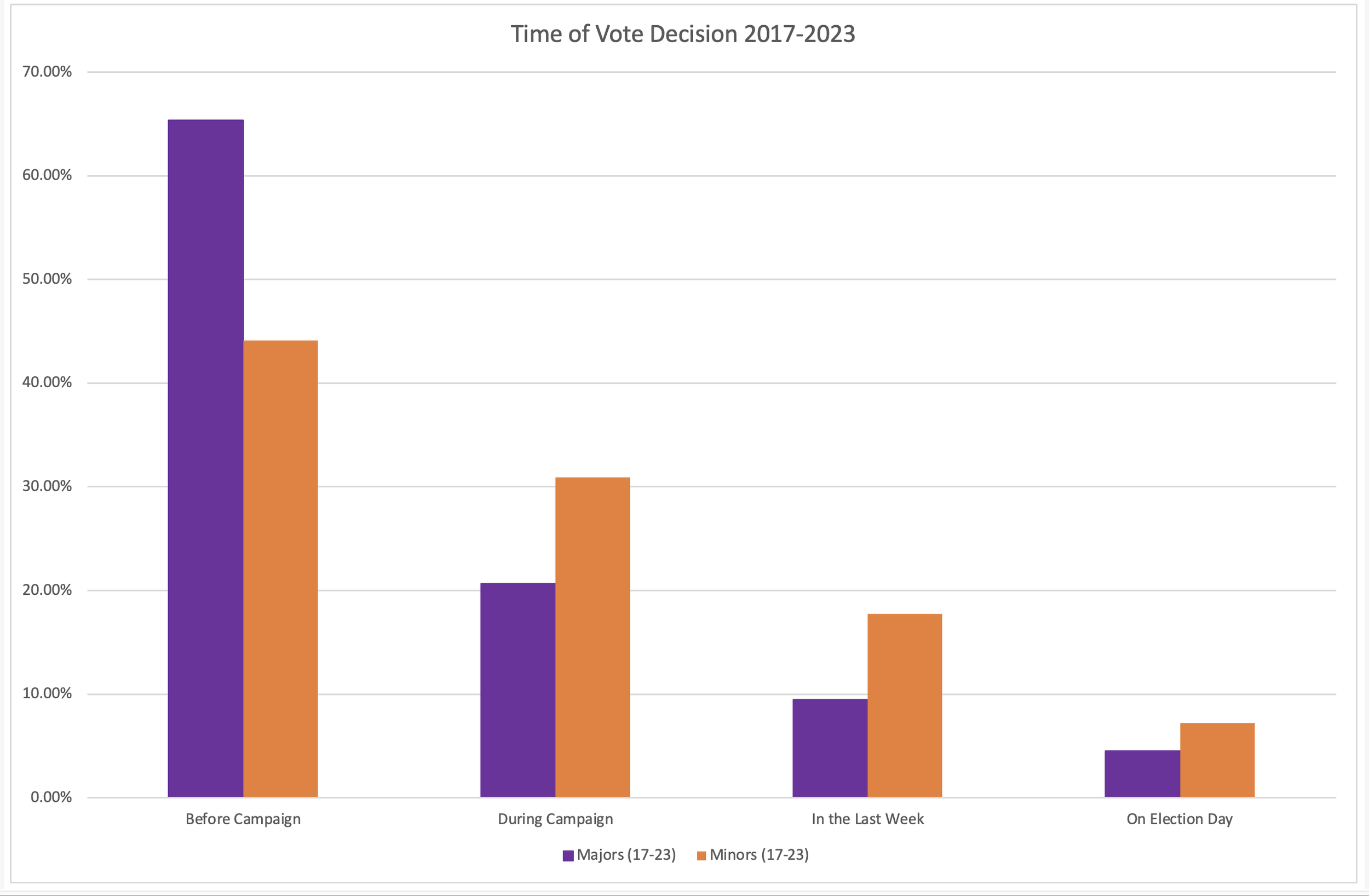
Data sourced from New Zealand Election Study
It’s different for minor parties. Only 44 percent of their voters are locked in before the campaign. A quarter decide in the final week or on the day. These are volatile, live deciders contemplating, but not yet fully committed to, a vote for a minor party (see chart below).
Winston Peters knows full well these voters are still in play. Yesterday NZ First dropped a campaign video under the heading “Give us your faith and your blessing, and, under Providence, all will be well", borrowing from the grammar of the American right to hoover up the faith-based fringe whose vote is normally wasted on micro-parties.
It is minor parties that National, Labour and their allies should be aiming their attacks at, not each other. If National wants a bigger party vote, it has to win back voters who have drifted to ACT, New Zealand First and Opportunity. Labour has to win them back from the Greens, Te Pāti Māori and Opportunity. Persuade these voters that a minor-party vote is a risk, and they may still return home to a major party.
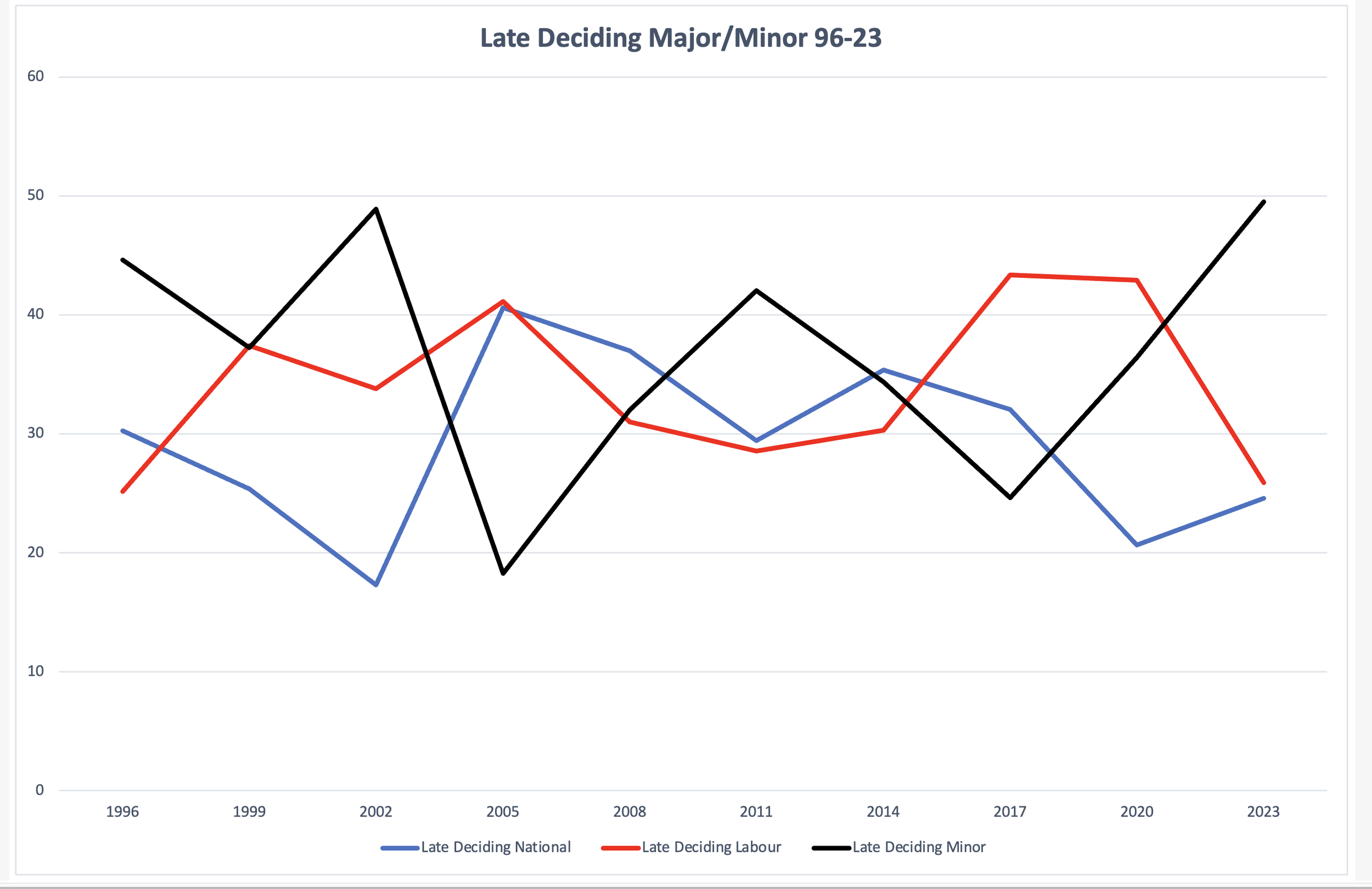
Data sourced from New Zealand Election Study
So why aren’t they going harder?
In marketing terms, what the major parties are suffering from is competitive myopia. A market leader concentrates on beating its traditional rival. Meanwhile smaller, nimbler brands peel off its customers one segment at a time. By the time the leader looks down, the rug has been pulled away from under them.
Except in this case the rug is staring the market leaders in the face! Both major parties know just where their votes have bled to.
Twenty ministers, from where?
Christopher Luxon has openly complained about having to govern with other “yahoo or numpty” parties around the Cabinet table, and last week repeated his wish for 20 National ministers around his next one. National holds 14 of the 20 Cabinet seats now. ACT and New Zealand First hold three each. To reach 20, National would need to nearly double its current polling. As shown above, those votes will not come from Labour. If they come from anywhere, they will come from ACT and New Zealand First.
So why is National holding back on attacking these two parties? It will be one of the big questions asked after the election, when analysts try to understand how both major parties sank so low.
It can’t be fear that ACT or New Zealand First will defect to Labour. Both have ruled that out. Is it loyalty to the mateship of “the coalition”? But the coalition is not on the ballot. It has no manifesto, no list, no members and no leader who can be removed. As a future government it does not yet exist. Surely National would not sacrifice its own growth to defend a fiction?
Is it campaign naivety? That might excuse Simeon Brown, running his first campaign as chair. It doesn’t excuse Luxon, who spent his pre-political career in marketing, and should know better.
Of course, shuffling votes within the bloc might win National more Cabinet seats, but it does not get the bloc over the line. For that, National needs Opportunity to finish below 5 per cent and win no electorate. That would remove the left’s only clear route to a majority.
So Opportunity, not Labour, is the party National and its allied lobby groups should be going after. In every debate, every ad, every interview and every social media post. Ruling Opportunity out of a coalition, as Luxon does often in media standups, is insufficient. National should be putting as much effort into critiquing Opportunity’s policies as it currently puts into Labour’s.
Haere rā frenemies
If National needs Opportunity to fail, Labour needs it to succeed and cross the five per cent threshold. The cost is that Labour must watch some of its support drift to Opportunity and do nothing about it.
That is no reason to wave haere rā to the voters also heading out the door for the Greens, however. In the Helen Clark era, Labour worked hard not to share the left vote. Today’s Labour is softer, treating the Greens as flatmates, not ruthless competitors. But this is a zero-sum market. Labour cannot afford to be mates with a rival whose growth is provided by its own decline. Ruling out Chloe Swarbrick as Finance Minister is insufficient. Labour should be putting as much effort into critiquing the Greens’ policies as it currently puts into National’s.
Less than three weeks to look up
This is the oddest contest I have observed in a long time. Two major parties, both near their floor, are spending the final weeks trying to attract voters who decided months ago. Meanwhile, they treat their true competitors as friends. National is protecting a coalition that is not on the ballot. Labour is protecting a frenemy that is eating its base. And the one party that could decide who governs is having a great old time and getting stronger by the day. If the major parties don’t turn their focus away from each other and onto the minor parties in the next three weeks, not only will they find the rug pulled out from below them, but the floor will have completely disappeared as well.