For the first time since we abandoned First-Past-the-Post, we have an FPP-like election-night result. Electorate seats, not the party vote, look set to decide who governs for the next three years.
Across the news media, social media and the political beltway, a chorus claims the 2026 result broke the central rule of MMP: that the party vote alone decides the balance of power in Parliament. There are calls to rewrite the electoral rules to eliminate overhang seats and demands for an urgent inquiry. Some want MMP dumped altogether.
An inquiry into whether the overhang provision serves its purpose is worthwhile. Whether it would diagnose the problem correctly is another matter. There are four main factors at play, and only one of them is legislative:
(i) The odds of this happening again, and the swing of the electoral pendulum
(ii) The major parties’ poor showing
(iii) What voters have been “sold”
(iv) The Electoral Act 1993, and how Parliament altered the Royal Commission’s blueprint.
Probability and imperfection
Before overhauling an entire electoral system on a sample size of one election result, we should ask whether this is simply the imperfection every system carries. As the 1986 Royal Commission on the Electoral System put it: “Every voting system is the product of a balancing of desirable and potentially conflicting objectives. It follows that any system will have its imperfections.”
The Commission foresaw overhangs and deliberate manipulation of the system. It described them as “unlikely”, “remote”, “accidental” and “extraordinary”, not a fatal flaw. Across 11 MMP elections, this is the first time an overhang has threatened to influence who governs, which surely meets the test of extraordinary.
Nonetheless, recency bias tempts us to treat the extraordinary as the new normal. Former Prime Minister and constitutional lawyer Sir Geoffrey Palmer warns: “How big a House of Representatives will ultimately result from overhangs, over years, is anyone’s guess.”
The gloom hasn’t been helped by Harry Mowbray and Te Pāti Māori openly trying to work the overhang rules for their preferred bloc. Any hint that wealthy donor activists or Māori are gaming the system raises public suspicion. The belief that the overhang was engineered has drawn attention away from the real issues.
So how likely is a repeat? Not very. For 2026 to recur, an unlikely mix of variables would have to line up again. Chief among them, both major parties would need to be as historically and equally unpopular as they are now. In a typical MMP election, the leading major party wins 38 to 47 per cent of the party vote. In 2026, National and Labour both finished below 30 per cent.
That is not the electoral system’s fault. It reflects the major parties’ failure to inspire, engage and earn trust. In 2026 the minor parties caught voters’ imagination, while the majors did not. Both should lift their game before 2029.
Of course, a hung Parliament could send us back to the polls within months. Even then, National voters would now be alert to how their party vote affects government formation, which makes a repeat low party vote less likely.
The pendulum
Then there’s the electoral pendulum.
For most of our modern history, New Zealand politics has run on a natural cycle, as I wrote in my first column. Each government had time to deliver its agenda before voters tired of it and swung to the other side.
In 2017 that swing hadn’t come. National still won 44 per cent of the party vote, a figure Luxon and Simeon Brown could only dream of today. Winston Peters chose Labour anyway, and stopped the pendulum before it had turned. Ever since, our politics has lurched from one overcorrection to the next.
2026 adds a twist, suggesting the existence of a two-speed pendulum.
At the electorate level, National’s vote behaved like a normal first-term government seeking re-election – a gentle drift as the pendulum began to swing away. National’s electorate vote fell just 2.21 points, from 43.47 per cent in 2023 to 41.26 per cent on election night.
It was the party vote that lurched, collapsing 8.87 points, from 38.08 to 29.21 per cent.
Had National dropped its party vote at a normal level for a first-term government, say down to 35 to 36 per cent, it would have been entitled to 43 or 44 of 120 seats. Its 42 electorate wins would have fitted inside that with no overhang.
The blame for the party vote collapse sits not with National’s electorate voters or the electoral system, but with National’s leadership.
The myth vs the leg
Then there is the question of what voters were sold in 1992 and 1993.
During the referendum campaigns, the Electoral Referendum Panel and reform champions reduced MMP to a slogan: your electorate vote picks your local MP, and your party vote decides each party’s share of Parliament.
Over ten elections that shorthand hardened into gospel. We hear it repeated every election and see it on our television screens as colourful graphics that translate opinion poll rankings into seats in the House. The Electoral Commission even has a graphic on its website that equates party vote proportionality to “the same proportion of seats in parliament” (see below), even though elsewhere on its site, it more correctly states, “The party vote largely decides the total number of seats each political party gets.” [my emphasis].
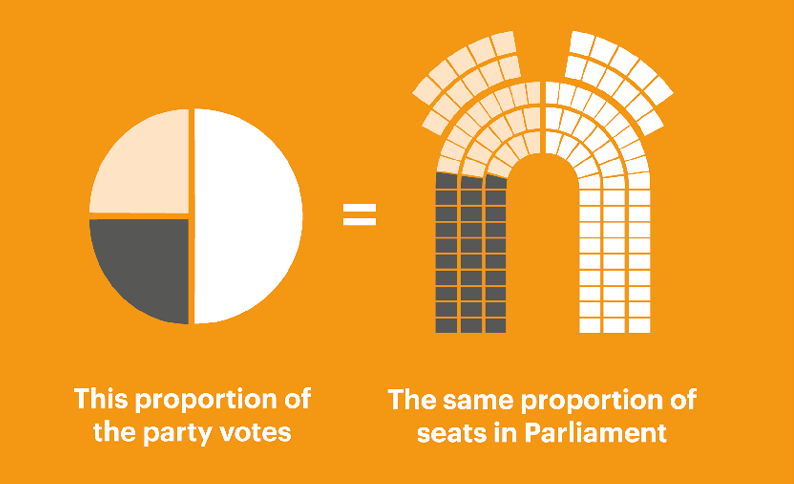
Labour campaign chair Kieran McAnulty echoed the myth recently when he worried about “an electoral system that was put forward on the basis of proportionality that is no longer guaranteed to bring a proportional Parliament.”
But unlike the graphics, the Electoral Act 1993 never provided for a Parliament that exactly mirrors the party vote.
Under the mechanism in the Electoral Act, proportionality applies to each party, measured against its own party vote. The mechanism works out how many seats each party’s vote entitles it to. It subtracts the electorates the party has won, and then list seats fill the gap. If a party wins more electorates than its entitlement, it keeps them all and gets no list seats. That is what happened to National in 2026.
Proportionality was always legislated as a floor, not a ceiling. No party gets fewer seats than its vote earns, but a party can get more. Those who say MMP’s proportionality is under threat are defending a promise the legislation never made.
Nor did the Royal Commission confuse seats with power. It noted that “proportionality between votes and seats is not necessarily the same as proportionality between votes and power.” Who governs is settled afterwards, when parties negotiate to form a majority. There is no automatic pole position for the party with the highest party vote.
That senior Cabinet ministers and the Speaker are now out of Parliament is not the electoral system’s fault either. The Commission expected lists to offer “the possibility of enhanced representation for minority and other special interests.” It never anticipated lists being used to park a government’s most senior ministers.
The blueprint Parliament altered
The Royal Commission recommended a 50:50 split: 60 electorate seats and 60 list seats in a House of 120, as a buffer. It meant there would be enough top-up seats to keep each party’s number of seats largely proportional, even when electorate swings ran hot.
But Parliament chose otherwise. The Electoral Act capped the House at 120 and tied electorate numbers to a fixed anchor. The South Island is guaranteed 16 general seats, and its average population per seat sets the quota for everywhere else. The North Island and the Māori roll grew faster than the South Island, so the Representation Commission had to keep adding electorates after each Census. They rose from 65 in 1996 to 72 in 2020, then settled at 71 for 2026. With the House capped, every new electorate cost a list seat. The buffer shrank from 55 list seats to 49. That was not enough to absorb an extraordinary result like 2026.
If MPs are troubled by overhangs, they don’t need to reinvent the electoral system. They need only honour the 50:50 ratio the Royal Commission recommended forty years ago.
What MMP is getting right
Step back from the seat count and the picture looks healthier. In 1981, a fifth of voters got two Social Credit MPs. In 2026, on preliminary results, the minor parties won just over twice the Social Credit party vote and gained 53 of 131 seats. That is roughly 40 per cent of the seats for 41 per cent of the vote. Even with the overhang, MMP has given minor parties a much fairer voice in Parliament than FPP ever provided.
MMP has also met the Royal Commission’s wider ambition of a Parliament that looks like the country. Party lists have turned a chamber of Pākehā male lawyers and farmers into a much more diverse legislature.
Before major party politicians rewrite our electoral law off one anomalous night, they might reflect on a simpler truth. MMP isn’t broken. Their connection with voters is.