To Breakfast or not Breakfast
Breakfast is the most important meal of the day, apparently — providing all manner of physical and mental health benefits that see us manage our days better and live longer. But not for Christopher Luxon, whose office announced on Friday 24 April that he would be skipping his regular Monday morning TVNZ parakuihi (well not exactly that word). His weekly interviews with Newstalk ZB’s Mike Hosking and RNZ’s John Campbell and Ingrid Hipkiss would remain.
After a review of regular media engagements late last year, we have decided to update our approach. Kiwis get their news in different ways – across radio, television, podcasts and digital platforms, and from next month, there will be three separate morning TV news shows. The PM will continue to be available to media, including Breakfast on a case-by-case basis.
It was almost identical wording to that used by Jacinda Ardern’s office in 2021 when Ardern stopped her regular appearances on Mike Hosking’s Newstalk ZB Breakfast show:
The Prime Minister's schedule of media appearances has been reviewed and while it hasn't reduced overall, it has changed. The PM will no longer do a weekly slot specifically on the ZB morning show. However she, and all her ministers, will continue to appear on the show as and when issues arise.
In both cases, ‘case by case’ and ‘as and when issues arise’ are code for: when the leaders get to control the issue being discussed and know more about the topic than the interviewer.
Prime Ministers pull back from live interviews for reasons that are personal, political, or performative — and usually some combination of all three. In Luxon’s case it’s very much the performative. He struggles with challenging interviewers, and Tova O’Brien is one of the sharpest in New Zealand. Luxon has not performed well in his encounters with her, and the flubs have gone viral. His comms team — which now includes experienced media personality Rachel Smalley — clearly decided getting him into sufficient form to counter Tova was too big a mountain to climb in the short term.
The calculated gamble appeared to land well the morning after, with a NZ Herald pop-up survey recording 70% agreeing it was the right call, 27% saying it wasn’t. Social media comments clustered around the view that he was right to walk away from a ‘biased’ interviewer — the standard partisan response on both left and right when a favoured leader is seen struggling.
But is it actually the right move? Let’s weigh up the costs and benefits.
The Benefits
Controlling the contexts in which leaders are seen is basic communications discipline. In situations where Luxon has control over the narrative—location, interviewer, subject matter, script, setting, lighting, edits — he has more room to present the version of himself his comms team wants voters to see: competent, trustworthy, in command, a man with a plan.
Avoiding situations where is not in control means avoiding the moments that go viral for the wrong reasons. In a media environment where a single stumble can dominate a news cycle for days, that calculation is not irrational. The risk is managed and his message reaches audiences directly without editorial interference. And in the short term, the polling may not punish him for it. As the Herald survey suggested, a significant slice of his base approves of him refusing to be grilled by a journalist they consider hostile.
The Costs
TVNZ Breakfast’s linear (watching as scheduled) audience of just over 100,000 is smaller than Hosking’s 400,000 or Morning Report’s 350,000 — but its digital reach is 283,000 and it carries 370,000 Facebook followers. Importantly, it reaches an audience the other shows don’t: busy professional parents getting ready for work or the kids ready for school — the ‘mum and dad voters’ who are not as politically tribal as the Hosking or Morning Report audiences. Overlooking them risks losing potential supporters.
It’s a similar story with TVNZ’s current affairs programme Q+A’s audience [Disclaimer: I was on the TVNZ payroll as a panelist between 2010 and 2017]. Christopher Luxon last appeared with Jack Tame in December 2024. John Key both appeared four times a year. Ardern appeared twice a year. Key never looked like he was enjoying himself, but he understood the strategic value of being seen in that arena. Luxon, by contrast, has apparently indicated he is not available for the rest of this year.
Q+A’s audience may be only 87,000, but they are opinion leaders — people who shape how others think and vote, and for that reason should not be written off completely this close to the next election.
Costs to shareholders
Then there’s the shareholder question, which doesn’t get discussed enough.
TVNZ is 100% owned by the taxpayer. The government, as our proxy shareholder, holds the TVNZ Board accountable for its financial performance, which flows back to the Crown’s books. There is no legal obligation for the Prime Minister to appear on its programmes — the TVNZ Act 2003 is explicit that Ministers may not give a direction to TVNZ in respect of any programme or other content or any complaint relating to a programme, and rightly so. But Luxon’s decision to avoid both Breakfast and Q+A is an implicit complaint and a form of editorial influence, both working against the interests of an asset the public owns.
It’s a complex arrangement. As the government that owns TVNZ, Luxon is the subject — the actor, the one with power over the asset. As the Prime Minister who appears on Breakfast to answer questions, he becomes the object — the thing being examined, held to account, acted upon by the interviewer and the public through them.
In this situation, he is using his power as subject to avoid becoming object. The entity that controls the broadcaster is withdrawing from the broadcaster's most politically consequential programmes precisely to escape the scrutiny that those programmes exist to provide! That is a tangled conflict of interest. Because of this, there is a case to be made for Prime Ministers to have additional expectations placed on them to appear on state media, irrespective of how personally uncomfortable it makes them.
The optics of leadership
Back in 2011 I published a leadership framework in an academic book chapter, which I subsequently turned into a model (latest version below). For any corporate CEOs reading, it can also be adapted for corporate comms.
The model draws on proxemics — the social science of interpersonal distance — to map how political leaders communicate, and audiences observe, mediated images of leadership at four different zones: intimate (the direct-to-camera address on a social media clip), personal (the one-on-one interview), social (campaign trail moments), and public (debates and speeches). Audiences infer leadership traits and characteristics from how the leader is seen interacting at each distance. To be successful, leaders need to be present and credible across each zone. Dropping out of one is not a neutral decision.
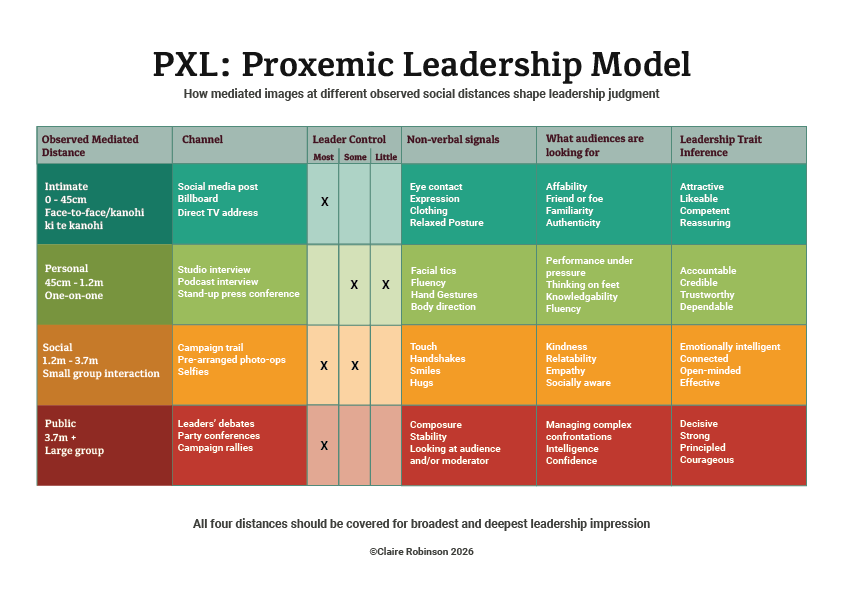
Leaders have varying degrees of control over these distances, which is why personal distance can be most revealing. At this distance, the media organisation/content creator holds most of the cards, and audiences are watching how a leader performs under conditions they don’t fully control: an interviewer who may push back, questions that weren’t pre-approved, a format that rewards composure and exposes evasion. Audiences read a leader’s non-verbal responses to assess how calm and self-aware they remain under pressure and infer important leadership traits such as credibility and trustworthiness from the observed responses.
Importantly, leadership judgements at personal distance are not formed in a single interview but across many, and they are among the most durable impressions a leader can make. Audiences learn a leader’s rhythms, their stress signs, their genuine warmth or its absence. Any departure from the established norm — a flash of irritation, a stumble, an evasion — may signal failure to cope. But it may also signal someone under an appreciable pressure, which audiences can empathise with.
No hiding
Luxon's team has calculated that protecting him from Tova O'Brien's scrutiny by focusing on radio over television outweighs the cost of his absence. Radio has its advantages: a leader can use notes that audiences don't see, giving them more control over their answers. His team may be right in the very short term. But in the longer game of leadership communication, you cannot build a relationship with voters you refuse to be seen by.
In Luxon's absence, opponents, commentators, critics and audiences will fill the gap themselves, and not necessarily in ways that help.
A Prime Minister is answerable to the public. Not just in the House, but in every proxemic zone — including the ones they can't control.