From Rhythm to Chaos
For most of our modern electoral history, New Zealand politics had a natural cycle. Like clockwork, voters would hand power to one side for three terms—nine years—then swing to the other. Labour governed from 1999 to 2008. National from 2008 to 2017. Before that, National held power for three terms through the 1990s. Once it held four terms, from 1960-1975, as did Labour from 1935 to 1949.
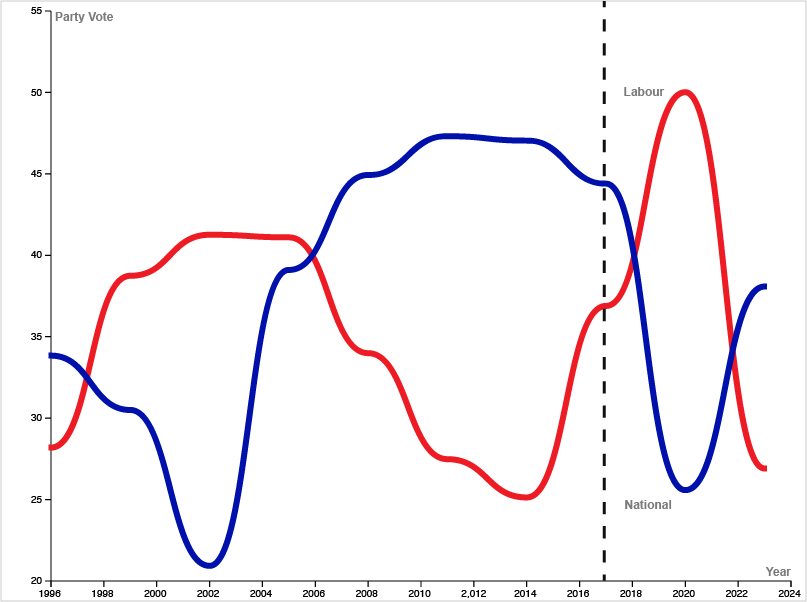
Chart 1: The political pendulum 1996-2024
The political pendulum (Chart 1 above) gave each new government sufficient time to implement its agenda before it ran out of ideas, started making mistakes and voters decided they'd had enough. The pendulum swung predictably, reliably.
Until 2017
That’s when NZ First leader Peters announced a decision that upended everything. Despite National winning the highest proportion of the major party vote in the 2017 general election, Peters chose Labour. It wasn't off-limits—that's how MMP works. But it violated an unwritten rule; that governments get replaced at the end of the cycle, not mid-way. By historical standards, National could have continued for another three years. That’s what major party voters wanted.
Peters’ decision stopped the pendulum nearing, but not at, the end of its swing. And ever since, New Zealand politics has been lurching from one overcorrection to another.
The Evidence Is Everywhere
Consider what's happened since that 2017 decision:
2020: Labour won 65 seats—an outright majority unprecedented under MMP. This wasn't a normal pendulum swing; it was an overcorrection. Voters, perhaps unconsciously trying to restore the balance Peters had disrupted, gave Labour more power than any party had held in 24 years of MMP. COVID played a major role, but the overcorrection had been signaled in the polls in 2019, long before COVID reached our shores. The scale of the victory suggests something deeper was at work.
2023: Labour collapsed to 34 seats—barely half its 2020 number; its second worst performance since the 1969 election. National roared back after only six years in opposition, not the traditional nine. Another overcorrection. National wasn’t prepared. Its new leader politically inexperienced. The pendulum wasn't swinging smoothly anymore; it was jerking violently between extremes.
2026: And now, 2026 is shaping up to potentially deliver another shock: National becoming the first one-term National-led government in the party's 90-year history. National has never led for less than three terms, ever. For a party that was once thought to be the ‘natural party’ of government, this will be a humiliating prospect.
The Pendulum Can't Find Its Rhythm
There have been 21 polls since early September 2025, and they're bouncing all over the place. Some show Labour ahead, some National. The average has National on 31.85%, Labour on 33.32%.
It is a statistically meaningless 1.5 percentage point difference. But under MMP, National has never overtaken Labour in the party vote when it has been behind Labour in the last half of the year before a general election. Of the 23 polls taken between July and December 2025, Labour was in the lead in 15 of them (65%).
Nor has any incumbent governing major party won the majority of the party vote when more New Zealanders believe the country is heading in the wrong direction, than the right (see Chart 2).
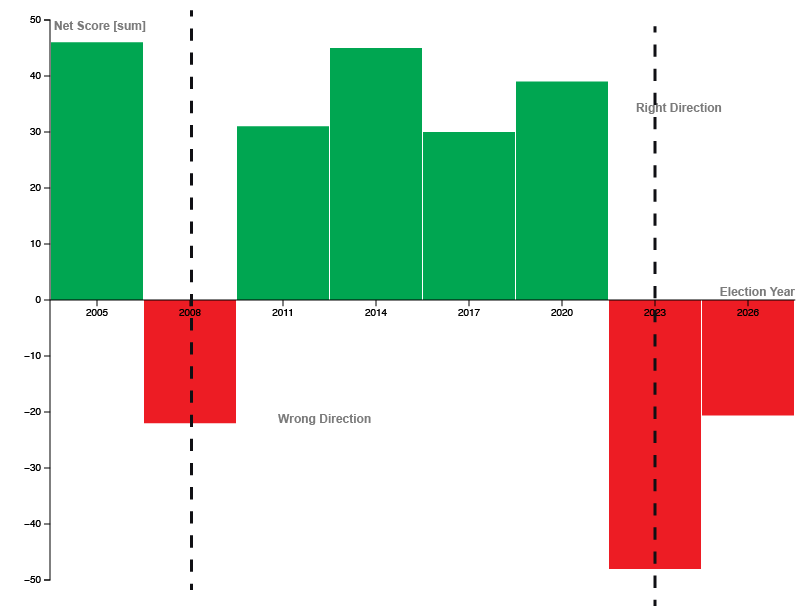
Chart 2: Right/Wrong direction. Dotted line is change of government
Things look just as bad for National when the ‘natural’ groupings or blocs on the left (Labour and Greens) and right (National and ACT) are averaged. These are the parties that share a core voter base; they effectively ‘eat each other’s lunch’. Since the beginning of this year, National and ACT together are averaging 39.125%, with Labour and Greens ahead on 44.75%, a 5.625% difference in the opposition’s favour. National can only cross the line with the assistance of New Zealand First (see Chart 3).
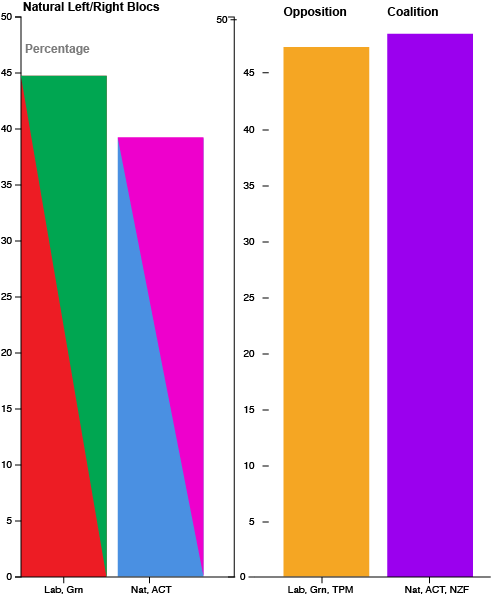
Chart 3: Natural voting blocs (left) v Opposition/Coalition including NZFirst (right)
If the pendulum had been swinging according to its natural rhythm, Labour would have entered government in 2020, not 2017, and would be looking for a third term in 2026. Instead, we are living with the consequences of a National party so desperate to govern following the 2023 overcorrection that it opened the floodgates for ACT and New Zealand First to sail through with a list of demands that was disproportionately long for the number of votes the minor parties brought with them. It’s National that has suffered most from this move, blocked from pursuing its own agenda over the past two years.
New Zealand isn't the only country experiencing political volatility. But what's happening in New Zealand is different. Global economic instability partially explains 2023's swing against Labour. It doesn't explain why we've had violent overcorrections in both 2020 and 2023, or why our traditional 9-year cycles have collapsed into 3–6-year chaos. The international trend is an anti-incumbent sentiment. Our problem is structural: a broken pendulum that can't find its rhythm. It’s in a doom loop.
***
It has been 51 years since Winston Peters first contested Northern Māori in 1975. He has seen the back of eleven Prime Ministers: From top left to bottom right, Muldoon, Lange, Palmer, Moore, Bolger, Shipley, Clark, Key, English, Ardern, Hipkins.

Peters wears this longevity as a badge of honour, treating politics like the TV show Survivor—outwit, outplay, outlast. But for what? He is fast becoming the contestant who won't leave the island even after the cameras have been turned off. If Peters was an ordinary employee, his manager would have scheduled that ‘difficult conversation’ by now: 'We've noticed a shift in your department's focus lately. How do you feel your current skills align with where the team is heading?' As evidence they might point to the many windmills the employee has been tilting at in recent weeks; his attacks becoming ever more unprovoked, his enemies imaginary, his goals futile and expensive.
Peters is crowing that his recent 10-11% polling is a sign of his party’s popularity. It’s not. New Zealand First is where protest votes go. It’s where partisan National and Labour voters put their votes when they don't trust either major party to govern competently in a broken system.
And who broke that system? New Zealand First in 2017. Oh, the irony.
MMP's Design Flaw
MMP's genius was that it let voters’ express frustration while maintaining stability through coalition building. Its flaw is that the system assumed protest parties would keep major parties honest from the opposition benches. Not from inside Cabinet.
When protest parties govern, they don't provide stability, they provide theatre and disruption. The instability voters are protesting becomes a self-fulfilling prophecy.
The Test Is Coming
If National loses in 2026—or wins by a margin so slim it needs New Zealand First again—it will be definitive proof the traditional rhythm that gave New Zealand decades of stable government is over.
And if Labour then wins in 2026 and also governs for only one term? Nail in the coffin. We're no longer swinging smoothly between left and right. We're jerking violently between extremes, with New Zealand First acting as the grain of sand jamming the mechanism every three years.
What's The Cost?
First there’s the four odd million dollars per year the New Zealand First parliamentary party costs taxpayers. Then there’s the huge cost to other parties and the parliamentary services of their coalition projects, like the current Bill to make English an official language. Such a low priority when the Education and Training Act 2020 already requires schools to compulsorily teach English from years 0-10 as part of giving effect to the New Zealand Curriculum Statement.
Then there's the bigger price: policy whiplash. Governments that know they have 6-12 years can make long-term decisions. Governments that might have only three years make short-term plays. The result:
Infrastructure projects get cancelled or redesigned every three years (e.g. the iReX new ferry plan). We aren’t building, we’re just re-planning.
Policy reforms get reversed (e.g. RoVE the reform of vocational education) at great disruption to critical industry employers and their workforces.
Constant churn in Cabinet and government agencies means we lose the institutional expertise required to solve complex, multi-decade problems
Business investment stalls and the cost to the taxpayer is immense.
Can The Pendulum Be Fixed?
Until one of the major party leaders finds a way to break the doom loop Peters set in motion in 2017, we're stuck with wild swings, short-term thinking, and a political system that lurches from crisis to overcorrection and back again. If the two leaders can't find a way to retire the protest party influence from the Cabinet room, New Zealanders may have to accept that the era of stable, nine-year cycles is a relic of the past—and prepare for a future of permanent political chaos.
Next week: Is there more can National can try?
23 February 2026